Commslayer vs Gorgias: which Shopify helpdesk is better?
- Researched and written by
- NSNikola Stevanovic , formerly Application Specialist at Gorgias

- Fact-checked by
- KKKarri Koivuniemi , CEO at Commslayer

- Published
- Last verified
Commslayer publishes this comparison and may benefit if readers choose it. Findings use current public sources, current Commslayer production code and customer-visible settings, and non-destructive checks in an active Gorgias account. No confidential Gorgias information was used.
Commslayer is a more affordable Gorgias alternative built specifically for Shopify. It bundles the helpdesk and AI Agent into one plan, while Gorgias combines a broader, more enterprise-focused platform with one bill where Helpdesk tickets and automated interactions are metered separately, plus Voice and SMS add-ons.
The practical choice comes down to what the team actually needs. Commslayer costs less in the examples below and includes more prebuilt Shopify and subscription actions verified in this comparison. Gorgias supports more commerce platforms in its Helpdesk, connects to more apps, and publishes a broader enterprise administration package.
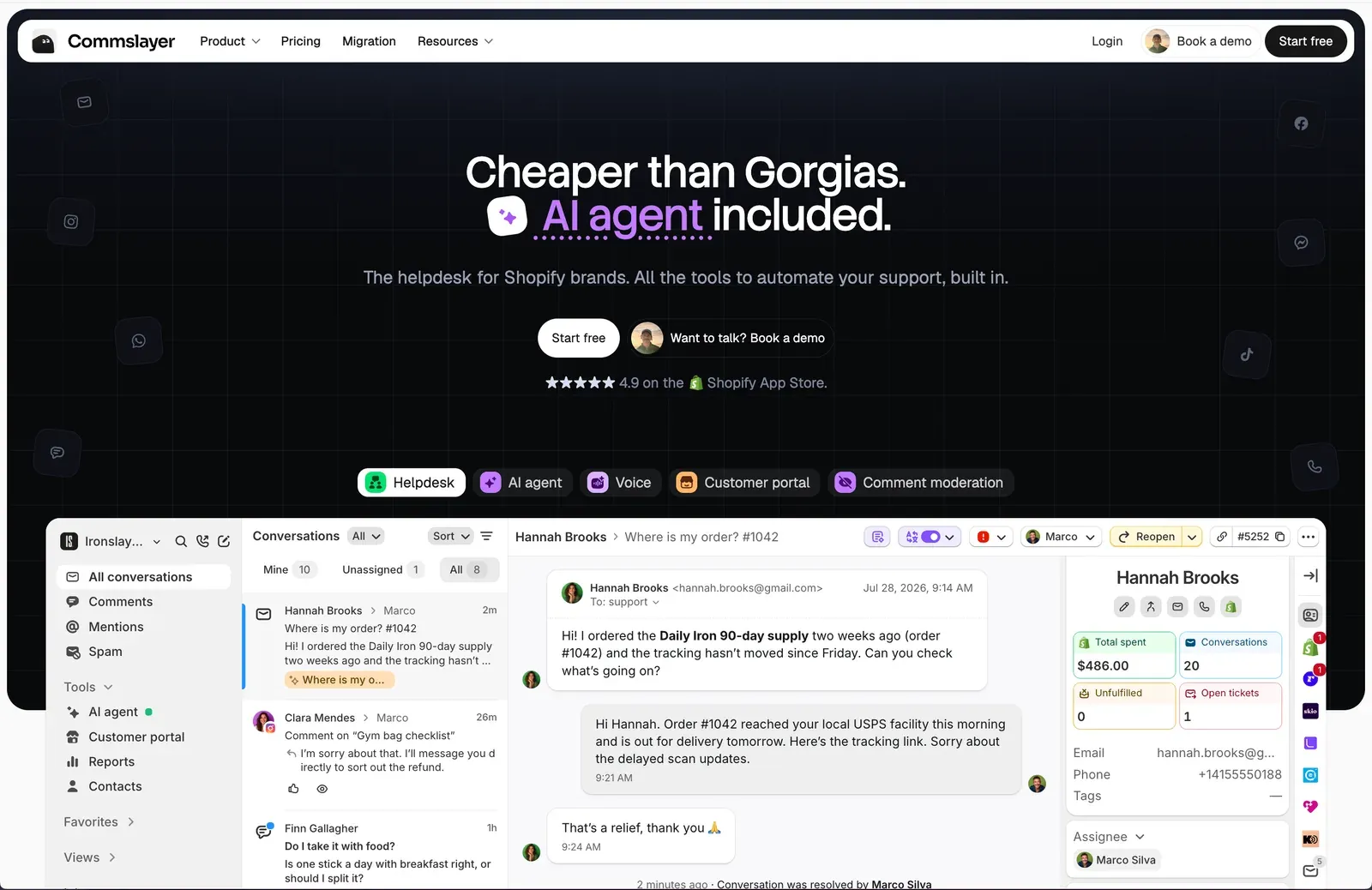
Why Shopify teams switch from Gorgias
Commslayer fits Shopify-only teams that want lower modeled costs, automatic AI drafts for human agents, and more ready-made order and subscription actions. Gorgias remains the safer choice for teams that need non-Shopify support, a specific integration, or enterprise administration controls.
The typical Shopify-first switch gains lower modeled cost, month-to-month flexibility, more predefined subscription and order actions, automatic two-way human translation, public-comment AI, and a storefront-native help center. It may give up parts of Gorgias’s integration breadth, non-Shopify coverage, enterprise administration, reporting, and existing custom-action setup.
| Area | Likely gain with Commslayer | Potential loss or rebuild from Gorgias |
|---|---|---|
| Cost and contract | Lower published modeled cost; month-to-month terms | A negotiated Gorgias Enterprise package |
| Agents | Unlimited agents on every plan and merchant-set overage caps, including a $0 cap | Existing Gorgias roles and team configuration must be recreated |
| AI actions | Broader predefined Shopify and subscription inventory; standalone guarded refund | Existing Gorgias custom actions may need to be rebuilt |
| Integrations | Shopify-focused stack with six named subscription platforms | A larger Gorgias ecosystem or a specific integration may not have a direct equivalent |
| Platforms | Concentrated Shopify support | Non-Shopify Helpdesk coverage |
| Translation and social | Automatic two-way human translation; public-comment AI | Existing Gorgias social rules and agent workflows need validation |
| Enterprise administration | Direct founder access and simpler buying | Gorgias procurement, identity, audit, and account-management capabilities may be required |
| Historical data | Imported tickets, contacts, tags, agents, and templates remain accessible | Automations and help-center content must be rebuilt |
Import your history in the background, run both systems while you test, and cancel Gorgias only after Commslayer earns it. See your price or plan your migration.
How do Commslayer and Gorgias compare at a glance?
At the two volumes where Gorgias publishes prices, 300 and 5,000 monthly conversations, Commslayer costs less: roughly 84% less at 300 and over 90% less at 5,000 on the monthly cards. At 20,000 and 60,000, Gorgias requires a quote. Commslayer also includes a larger set of prebuilt Shopify and subscription actions verified in this comparison. Gorgias publishes more of the administration and procurement controls that enterprise buyers look for, supports more commerce platforms in its Helpdesk, and has a larger integration ecosystem. Some enterprise controls are limited to higher plans, and Gorgias’s current AI Agent is Shopify-specific.
| Question | Commslayer | Gorgias |
|---|---|---|
| Best fit | Shopify-first teams prioritizing cost, AI execution, subscriptions, and a compact stack | Multi-platform, integration-heavy, or governance-heavy CX teams |
| Commerce platform scope | Shopify | Helpdesk supports Shopify, BigCommerce, Magento, WooCommerce, and PrestaShop; current AI Agent is Shopify-specific |
| Pricing and contract | One month-to-month plan with separate allowances for billable conversations, AI Agent messages, and AI drafts; no annual contracts | One monthly or annual bill with Helpdesk tickets and automated interactions metered separately, plus Voice and SMS add-ons; Enterprise terms are custom |
| AI and actions | Draft-only or autonomous replies; 31 customer-visible actions plus custom API actions; standalone guarded refunds | Autonomous AI after testing; documented Shopify, connected-app, and custom actions; refunds inside cancellation and item-change flows |
| Shopify and subscriptions | Built-in order actions, post-purchase self-service, and prebuilt actions for six subscription platforms | Shopping Assistant cart context, documented order actions, and confirmed AI actions for Recharge, Loop, and Skio |
| Translation and social | Automatic inbound and outbound human-message translation; automatic AI moderation of supported public comments with a ready AI draft reply for a human to send | Automatic inbound translation with agent-triggered outbound translation; human public-comment handling and private social AI |
| Phone and help center | Native human phone; help content served on the Shopify store domain inside the theme | Native Voice add-on; automatic Shopify embed, manual HTML embed, or standalone help center |
| Ecosystem and administration | Shopify-focused integrations, fully live read/write MCP, unlimited agents, and direct founder access | 100+ apps, MCP in open beta, and a broader published enterprise administration package |
Which features does each one include?
| Feature | Commslayer | Gorgias |
|---|---|---|
| Automatic AI drafts for human agents | ✓ Every incoming conversation | ✗ Reply workflow centers on macros |
| Automatic two-way human translation | ✓ Plus plans and up | ~ Inbound automatic; agent triggers outbound |
| Free plan | ✓ | — |
| Month-to-month plans | ✓ No annual contract or exit fee | ✓ Monthly or discounted annual |
| Unlimited agents | ✓ | ~ 500 seats, 3 on Starter |
| Prebuilt Shopify order actions | ✓ Ten predefined actions | ✓ Several confirmed native |
| AI order editing after checkout | ✓ | ✓ Remove and replace |
| AI-issued refunds | ✓ Standalone, with merchant-set guardrails | ~ Inside cancellation and item-change flows |
| Prebuilt subscription actions | ✓ 20 actions across six platforms | ✓ Recharge, Loop, and Skio |
| Customer self-service order editing | ✓ Thank-you page, chat, and order-status page | — |
| AI on public Facebook and Instagram comments | ~ Automatic moderation and ready drafts; human sends replies | ✗ No public posts, mentions, or comments |
| AI on Instagram and Messenger DMs | ✓ On supported connected channels | ✓ |
| TikTok comments | ✓ When connected | — |
| SMS | ✗ | ✓ Separate add-on |
| Native human phone with IVR | ✓ | ✓ Voice add-on |
| Voice AI | ✗ Coming soon | — |
| Custom API actions for AI | ✓ Authenticated REST | ✓ Visual multi-step builder |
| First-party MCP | ✓ Fully live, read and write | ~ Open beta; some writes gated |
How much do Commslayer and Gorgias cost?
Example monthly pricing at four support volumes, assuming 60% of conversations are fully handled by AI:1
| Monthly support conversations | Commslayer, month to month | Gorgias, month to month | Gorgias, annual-effective |
|---|---|---|---|
| 300 | $39 | $250 to $255 | $221 to $230 |
| 5,000 | $299 | $3,900 to $4,150 | $3,450 to $3,750 |
| 20,000 | $1,199 | Quote required | Quote required |
| 60,000 | $2,999 | Quote required | Quote required |
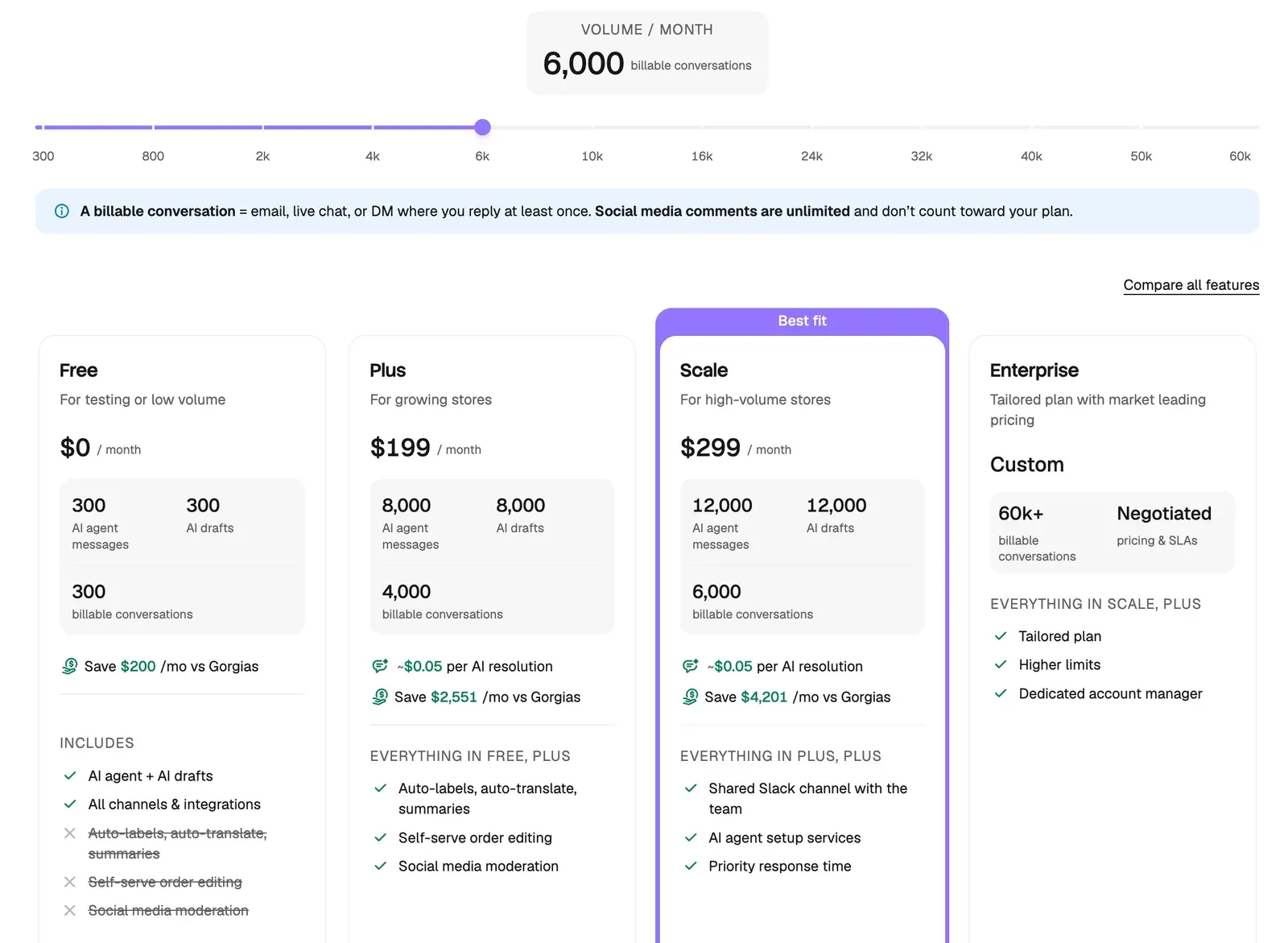
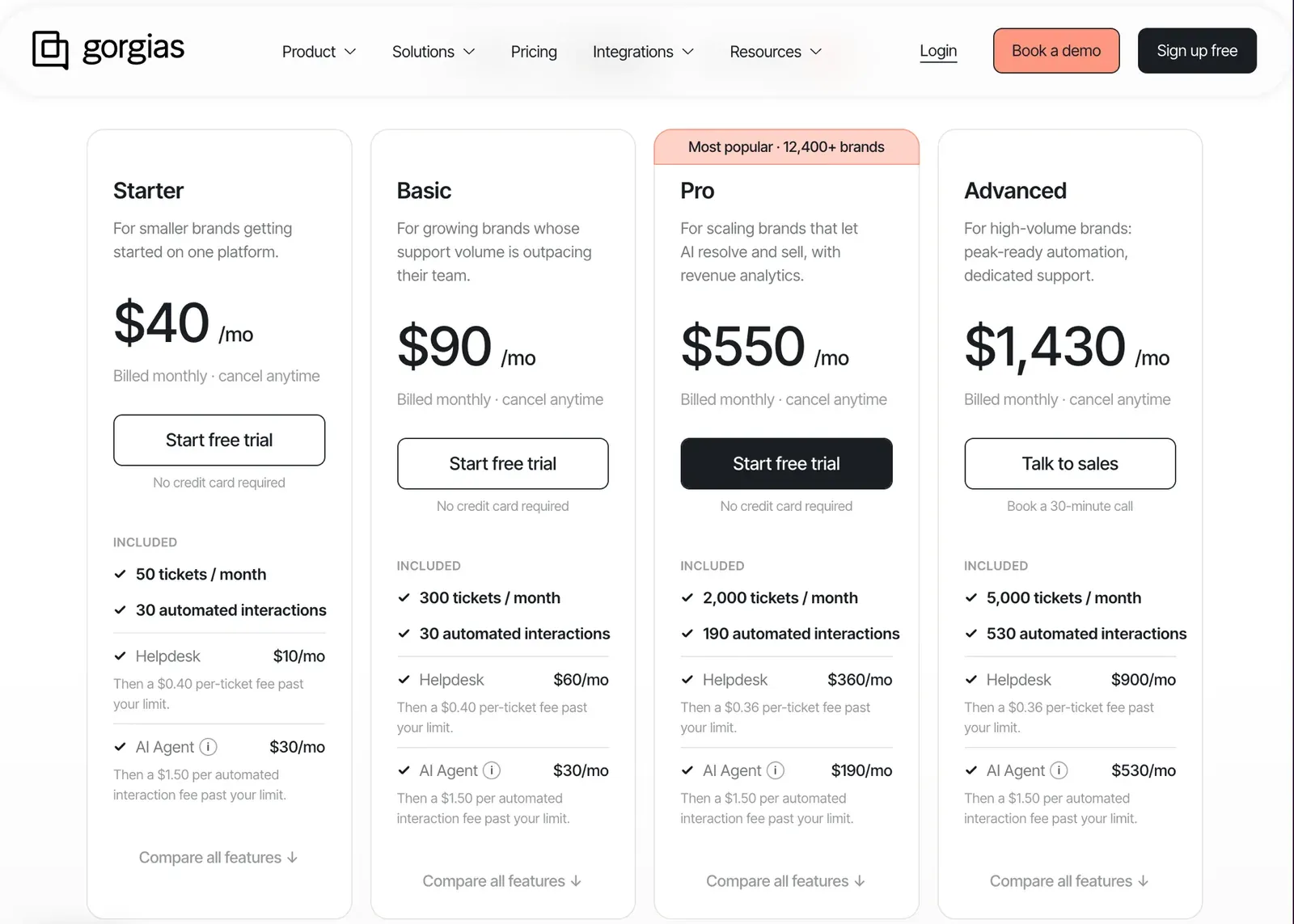
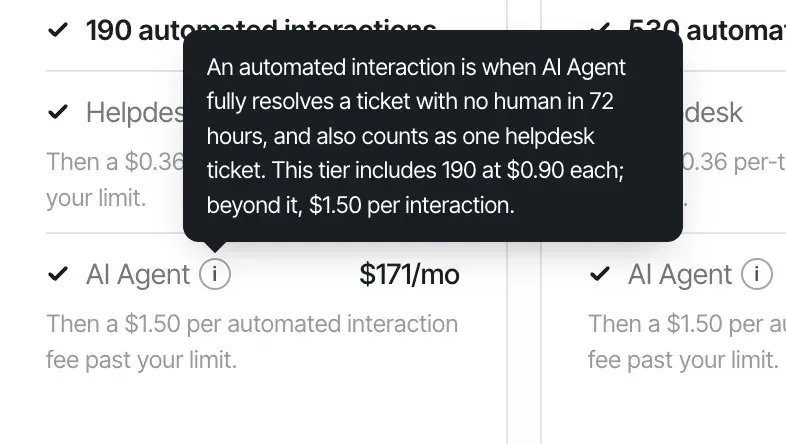
The examples use the same volume for both products: 60% of conversations are fully handled by AI, 40% receive a human reply, and each AI-handled conversation uses two Commslayer AI Agent messages, which is Commslayer’s own published planning assumption. In both products every replied conversation counts as billable, and AI-handled conversations also draw on the AI allowance. Gorgias’s pricing page states its version of the rule directly: an automated interaction is “when AI Agent fully resolves a ticket with no human in 72 hours, and also counts as one helpdesk ticket.” Commslayer’s AI drafts have a separate allowance and are not part of the model. We then selected the cheapest plan covering both required allowances, verified against Commslayer’s production billing code.
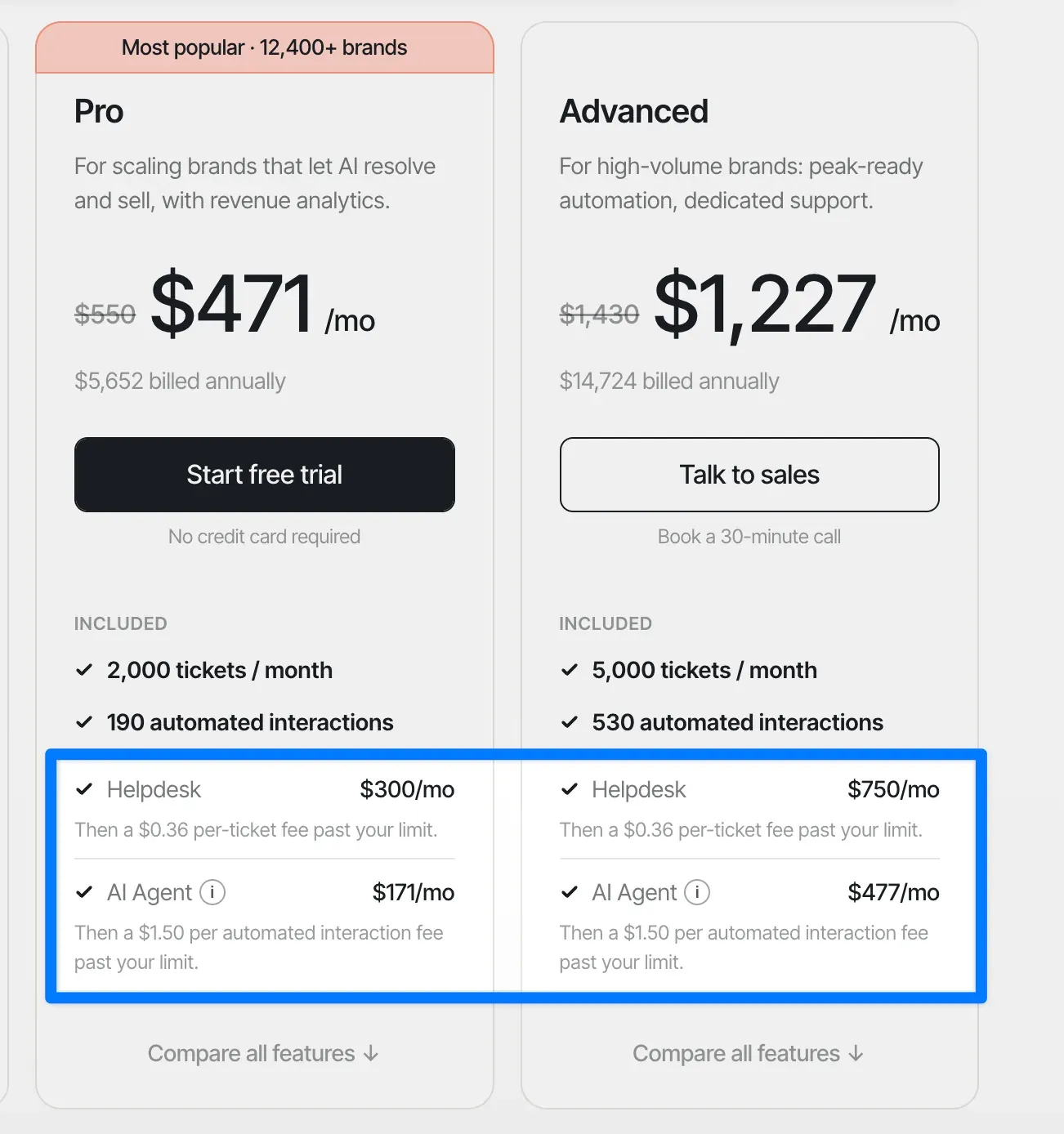
That selects Commslayer Plus at 300 conversations and Scale everywhere else. At 5,000 conversations, Plus tops out at 4,000, so Scale’s 6,000-conversation tier at $299, the tier shown in the capture above, is the more affordable covering option. Gorgias’s self-serve cards run from Starter at $40 with 50 tickets and 30 automated interactions to Advanced at $1,430 with 5,000 tickets and 530 automated interactions, with the AI Agent portion priced at $1.00 per included interaction.
Overage is where the gap widens. Commslayer charges a flat $0.15 per additional conversation and $0.075 per additional AI Agent message, about $0.30 for a fully AI-handled conversation. Gorgias’s cards list $0.36 to $0.40 per extra ticket and $1.50 per extra automated interaction, and because an automated interaction also counts as a ticket, an AI-resolved conversation past both limits can cost $1.86 to $1.90, roughly six times Commslayer’s rate. Commslayer’s overage cap also defaults to $0: until a merchant raises it, usage beyond the plan cannot create charges, and when the cap is reached the AI stops sending but keeps drafting while human agents keep replying.
See current Commslayer pricing or start free on Shopify.
How do their contracts and company models differ?
Commslayer is bootstrapped, profitable, founder-led, self-serve, and month to month. Gorgias combines self-serve entry plans with a more sales-assisted Enterprise offering and documents more procurement and administration controls for enterprise buyers. For buyers, the practical differences are contract length, access to founders or account teams, plan eligibility, and how much can be purchased without a custom quote.
Can I start without talking to sales?
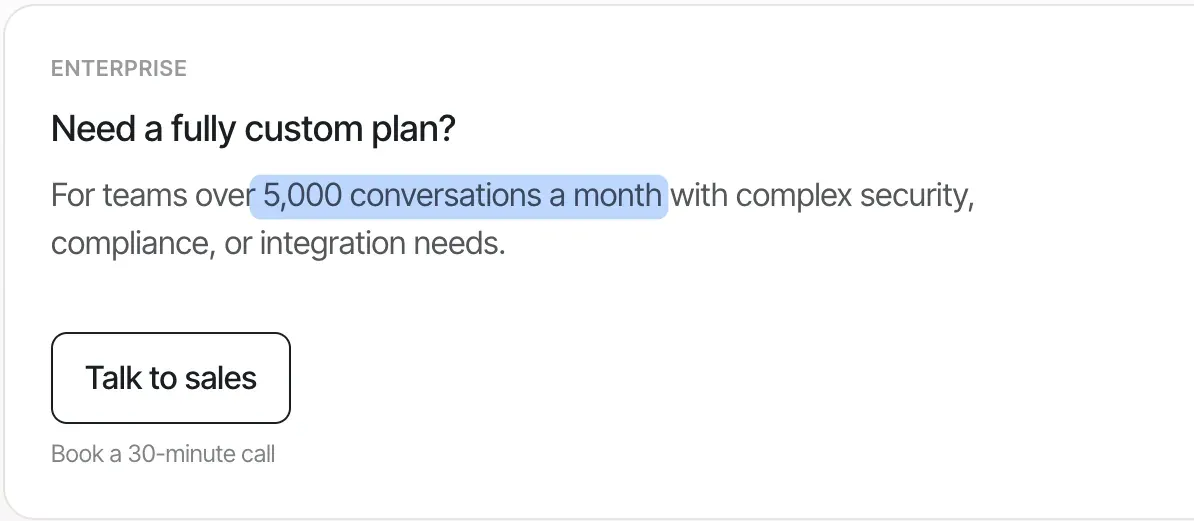
Commslayer can be installed and purchased self-serve on published plans through 60,000 monthly conversations, with unlimited agents. Above that volume, buyers move to a custom process with direct founder access. Gorgias also offers self-serve entry plans, but the current public Helpdesk catalogue moves to a custom Enterprise process above 5,000 tickets. Buyers who need a negotiated security review, custom terms, or large-volume pricing should expect a sales-assisted Gorgias process.
Do I need an annual contract?
Commslayer’s plans are month to month, with no annual contract or exit fee. Gorgias offers both monthly and discounted annual self-serve pricing, while Enterprise contract terms are quoted. The annual discount can reduce Gorgias’s effective monthly rate, but it also turns twelve months of spend into a first-year commitment.
How do the Commslayer and Gorgias AI Agents compare?
Commslayer’s AI support agent for Shopify offers more prebuilt Shopify and subscription actions verified in this comparison, plus draft approval, automatic two-way human-message translation, and public-comment moderation. Gorgias combines autonomous support with Shopping Assistant, a larger integration ecosystem, and a wider set of documented enterprise controls. Both handle email and live chat, but their action models, approval workflows, channel coverage, and billing differ.
How do the AI Agents compare at a glance?
| Area | Commslayer | Gorgias |
|---|---|---|
| Best fit | Shopify-first teams prioritizing predefined actions, approval controls, translation, social comments, and lower modeled cost | Teams prioritizing Shopping Assistant, a larger integration ecosystem, and enterprise administration |
| Reply mode | Draft-only with human approval or autonomous sending by enabled topic | Autonomous sending after testing and deployment |
| AI drafts for human agents | Automatic draft prepared for every incoming conversation, no extra step; separate draft allowance | No AI-draft generation in the conversation view; the human reply workflow centers on macros |
| Prebuilt actions | 31 customer-visible actions across Shopify, conversations, and six subscription platforms | Documented Shopify and connected-app actions, plus custom actions |
| Controls and handover | Per-action enablement, topic controls, approvals, confirmations, testing, and merchant-set guardrails | Skills, handover topics, answer-quality checks, conditions, shopper confirmation, test conversations, and action logs |
| Context | Shopify customer and order context used by built-in order and subscription actions | Shopify customer and order context; Shopping Assistant can use current-session cart and browsing context |
| Billing | Separate AI Agent message and AI draft allowances inside the same plan; using one does not reduce the other | Automated interactions metered separately from Helpdesk |
Does the AI work on email, chat, DMs, and public comments?
Both AI Agents work on email and live chat. Commslayer also handles Instagram and Facebook Messenger DMs, automatically moderates supported public Facebook and Instagram comments, and prepares a ready AI draft reply for each comment; a human sends public replies. Gorgias AI supports email, chat, SMS, Instagram DMs, and Facebook Messenger, but it does not moderate or reply to public posts, mentions, or comments. Commslayer SMS is not shipped; Gorgias SMS is a separate add-on.
Can the AI draft replies without sending them?
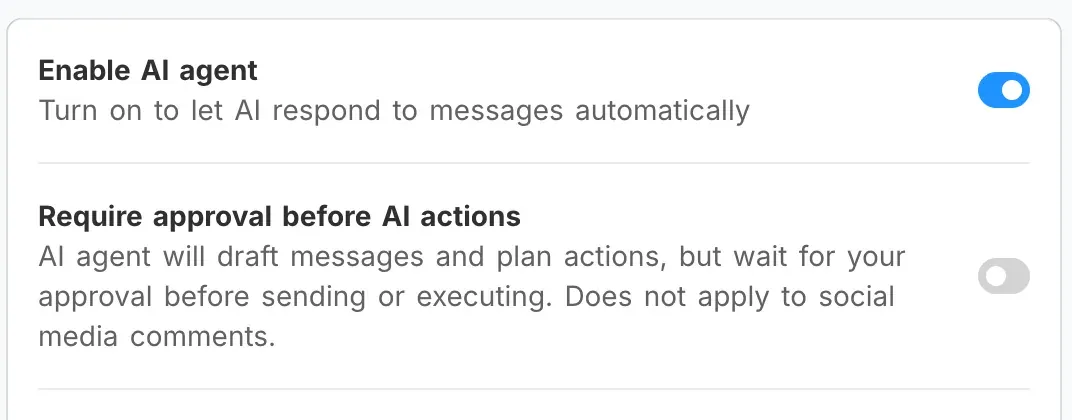
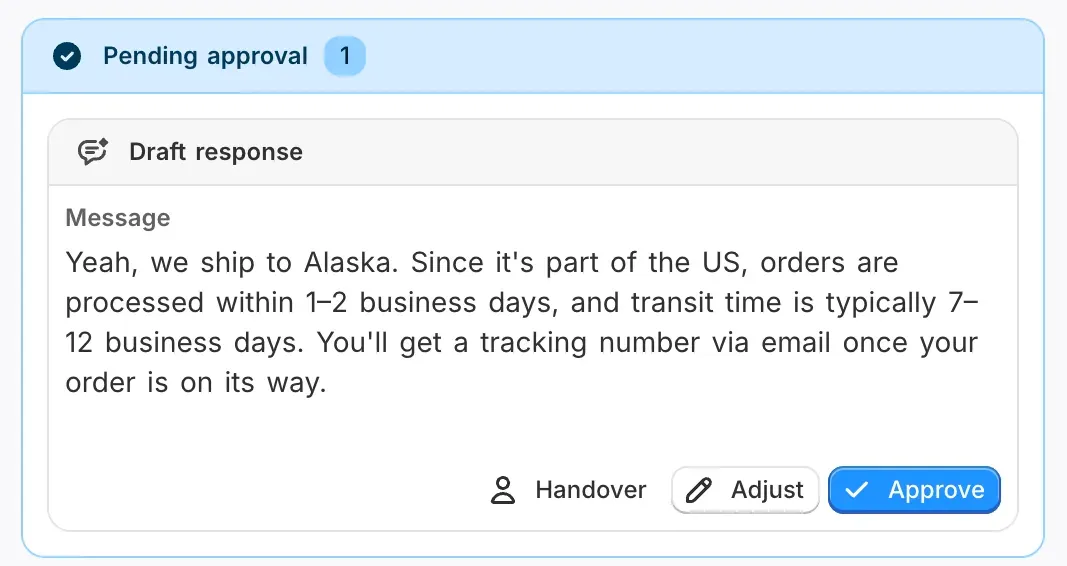
Commslayer can stay in draft-only mode so a human approves each proposed reply, or it can send autonomously for enabled topics. Its AI Playground can test conversations with customer and Shopify context, show the matched guidance and AI reasoning, and keep new guidance in testing status so it runs only in the playground. Most built-in actions are simulated by default. Custom HTTP actions can call connected systems, so merchants should treat them as live unless they are separately protected.
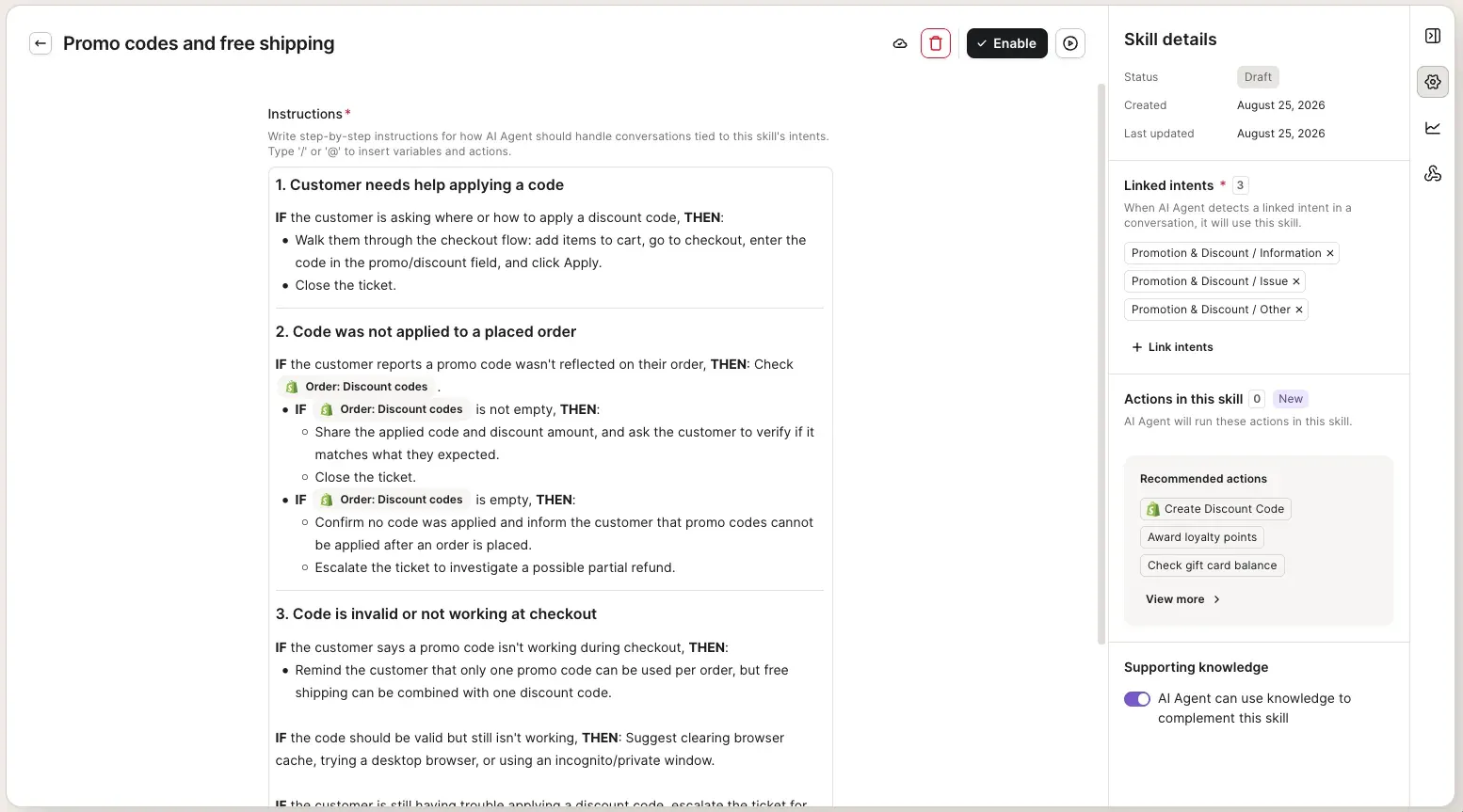
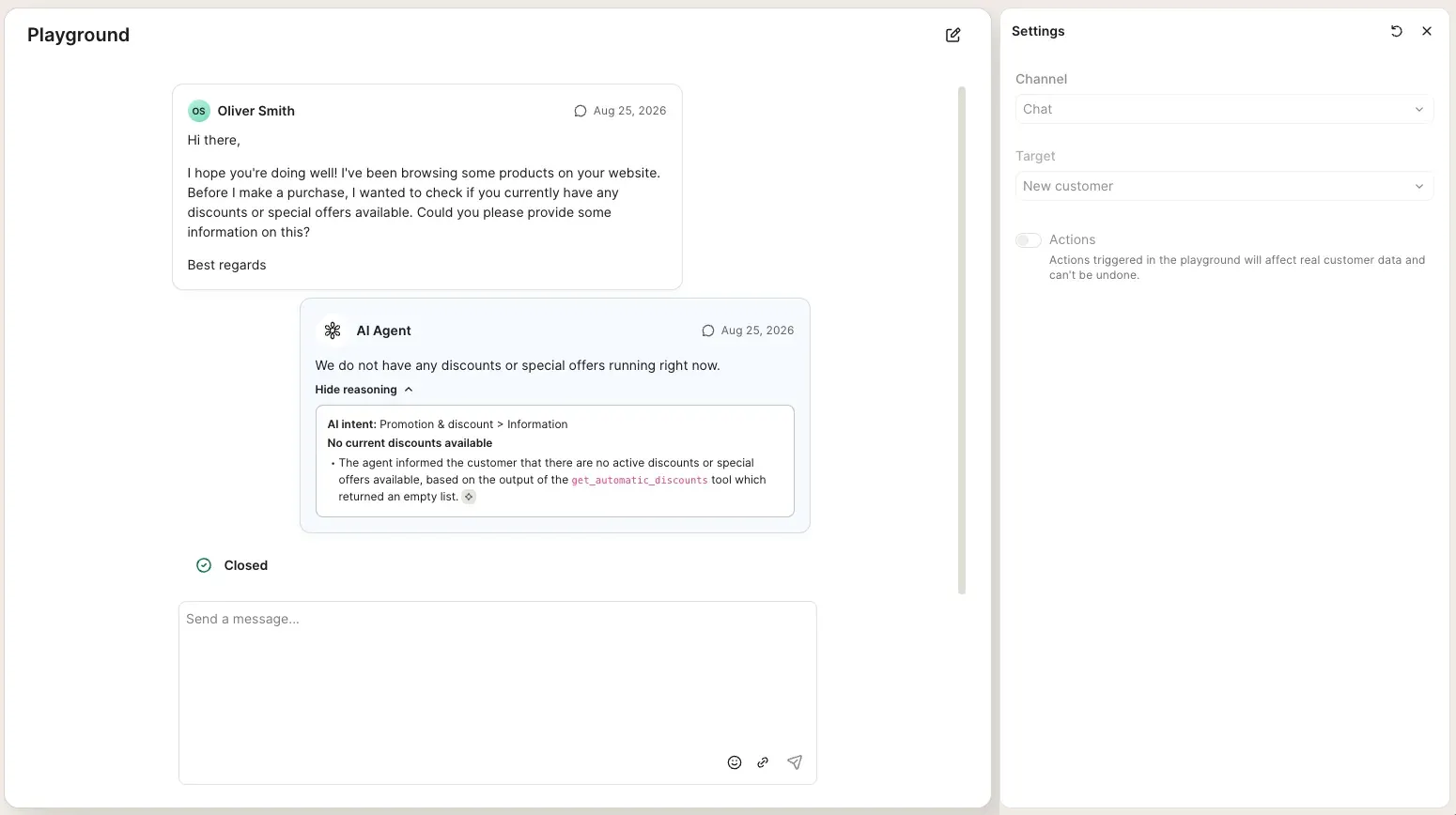
Gorgias AI Agent is designed to send supported customer conversations autonomously once deployed. Its Playground shows response reasoning and the knowledge and customer context used, and it can test unpublished skill, guidance, and Help Center drafts before they go live. Actions are off in tests by default. Enabling them can change connected customer or order data, so Gorgias recommends targeting a fake customer profile. This is not the same as requiring an agent to approve every live AI reply.
Message approval and action confirmation are separate controls. Gorgias can ask the shopper to confirm an action before it runs. Merchants choose which actions need confirmation, and for some irreversible actions Gorgias switches confirmation on by default. Commslayer lets merchants control reply approval, enabled guidance, and action availability separately. On eligible email and social inboxes, it can reply only when a message matches enabled guidance and leave unmatched topics for the team. Chat and WhatsApp are not restricted by that setting. Standalone refunds also have merchant-set financial limits.
Which drafts replies for human agents automatically?
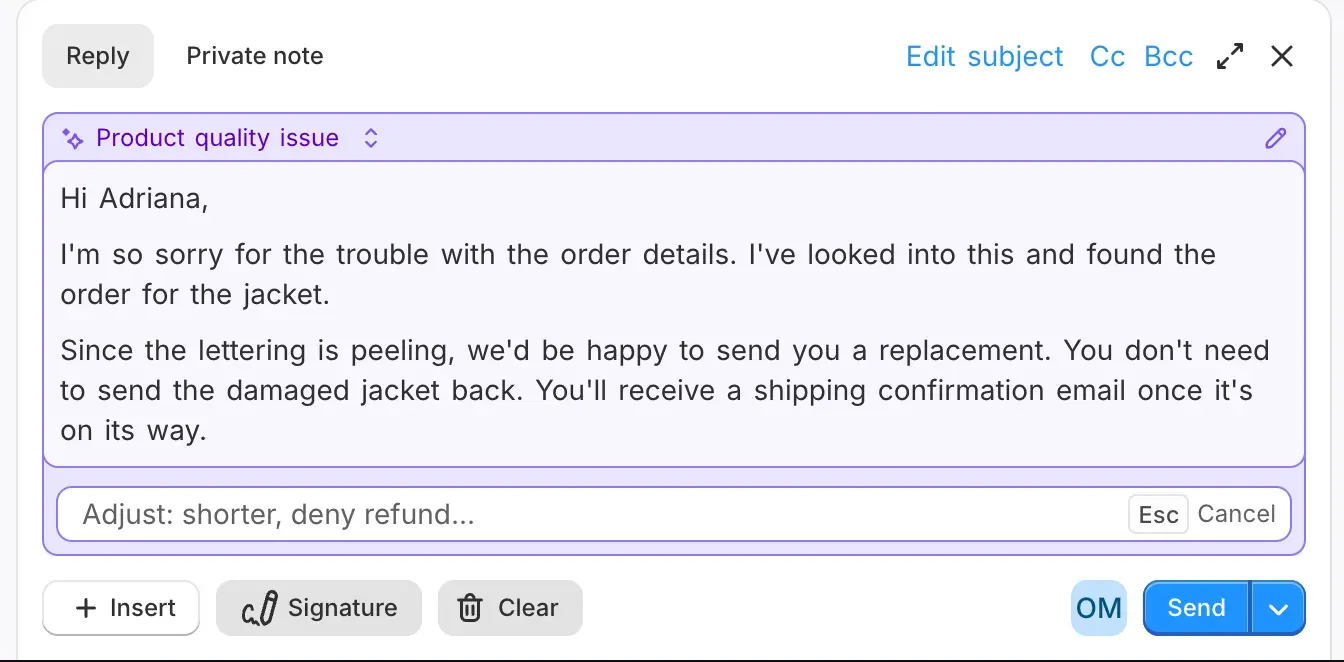
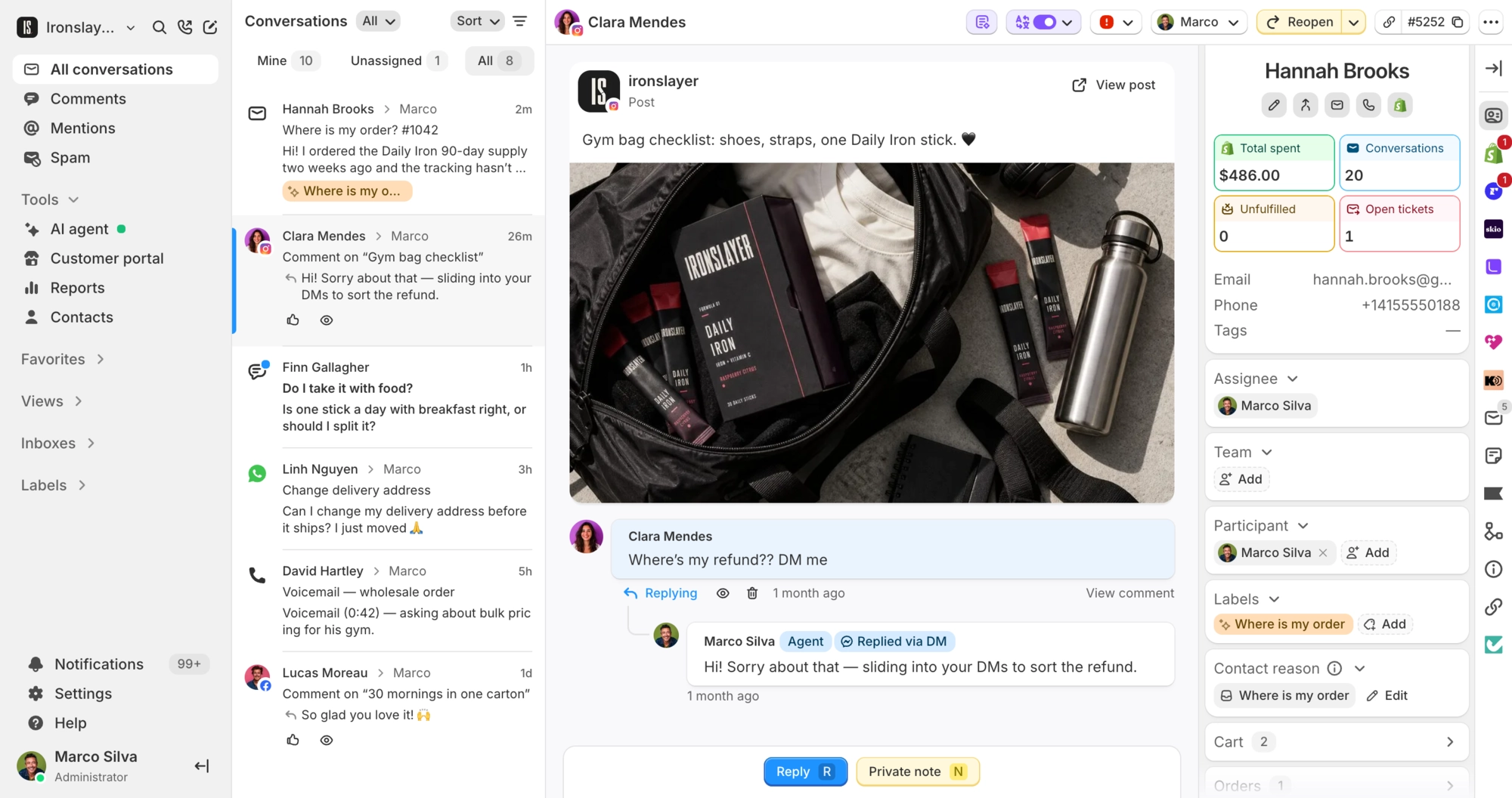
Commslayer automatically prepares an AI draft for every incoming conversation a human agent handles. The draft is already waiting in the reply box when the agent opens the ticket, with no button press or generation step: the agent can send it, adjust it with a short instruction, or discard it. These drafts use Commslayer’s separate AI-draft allowance and do not consume AI Agent messages, as described in the pricing model above.
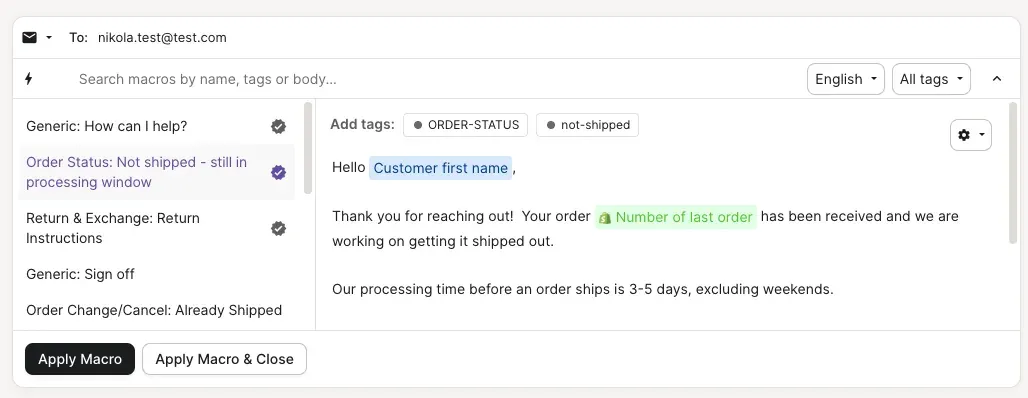
Gorgias has no equivalent. Its AI Agent either sends a supported reply autonomously or hands the conversation to a human, and the human reply workflow centers on macros; the conversation view offers no control for generating an AI draft. This was checked in the active Gorgias account on August 24, 2026.
How do controls and human handover work?
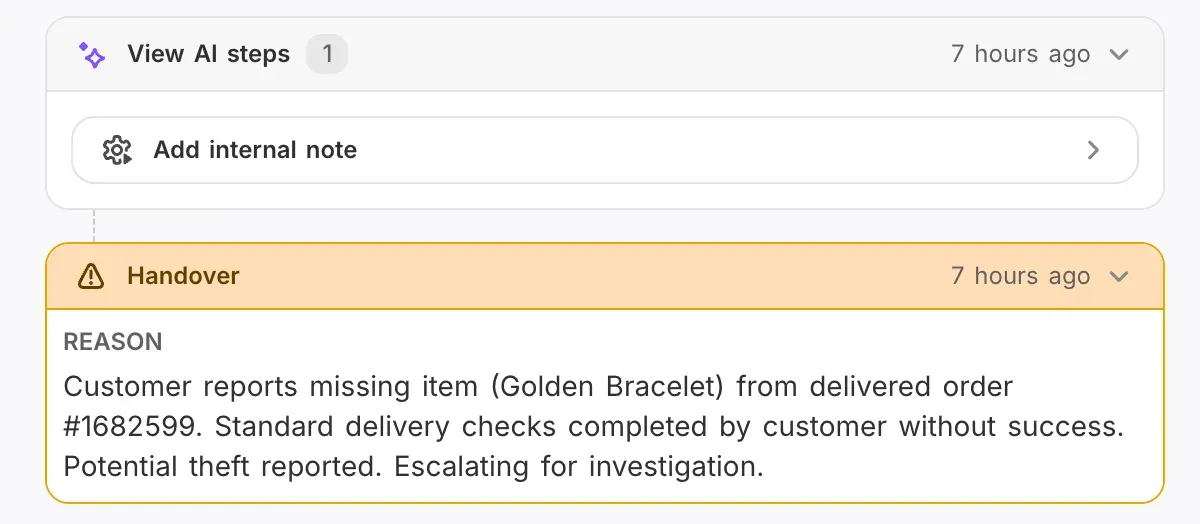
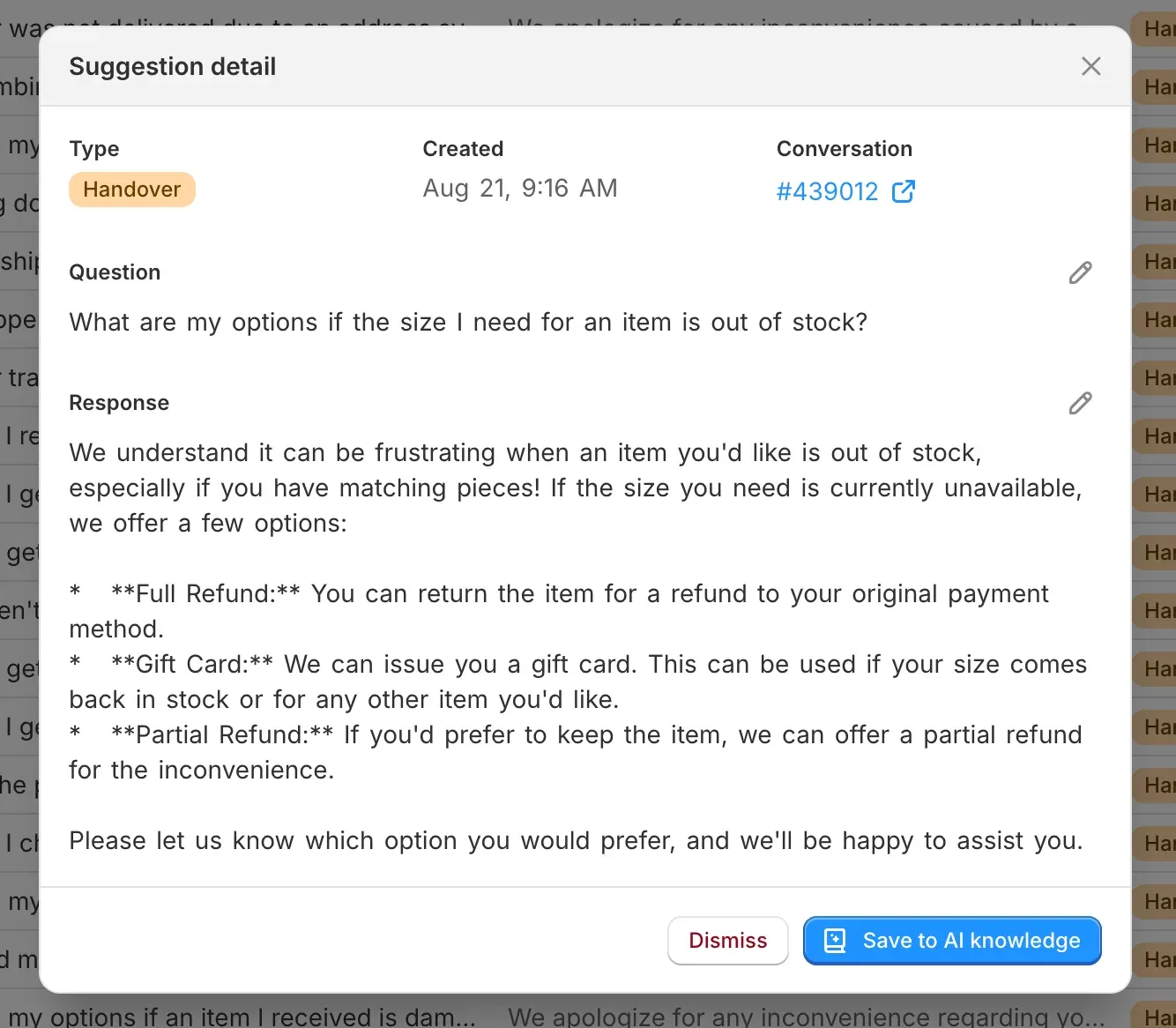
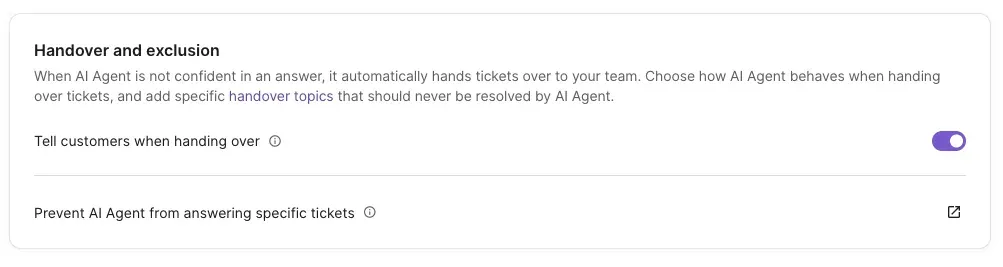
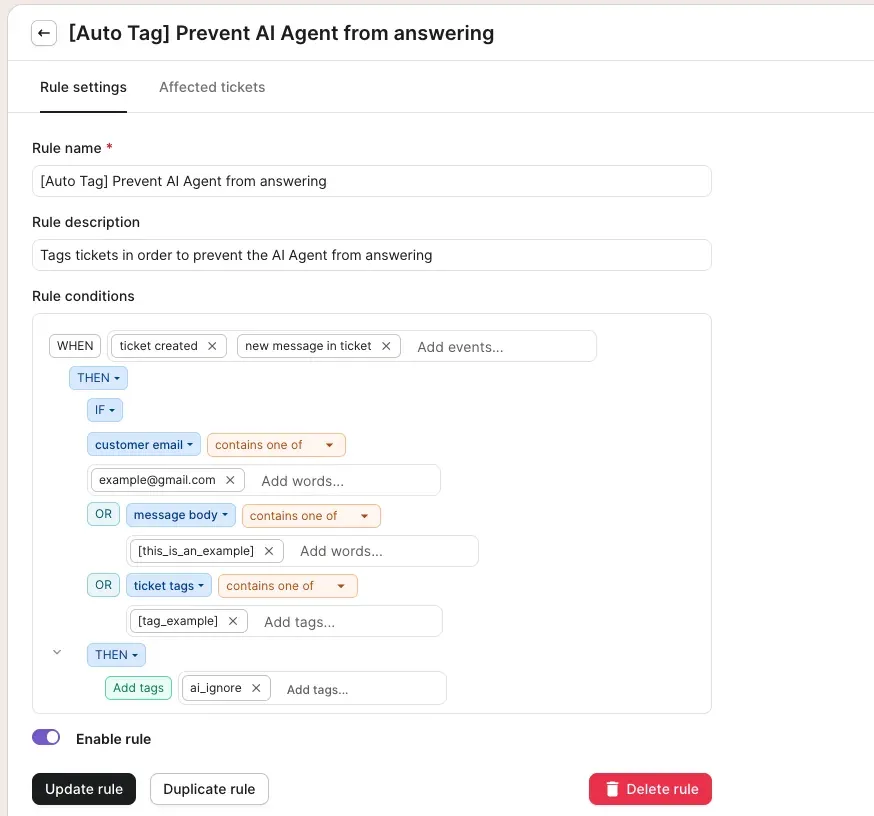
Both products let a team limit what AI handles and send uncertain or restricted work to a human. Commslayer supports per-action enablement, topic controls, draft approval, human confirmation, testing, and merchant-set guardrails. Gorgias supports skills, handover topics, answer-quality checks, conditions, shopper confirmation, test conversations, and action logs. Its documented handover behavior escalates when knowledge is insufficient, the drafted answer does not meet its quality check, or the topic is configured as off-limits.
One plan-gating difference: Commslayer includes proactive knowledge-gap detection on every paid plan, surfacing the questions its AI could not answer accurately so the team can fill the missing knowledge. Gorgias’s pricing page lists its comparable knowledge-gap capability as an Enterprise feature. Gorgias’s own plan comparison also lists brand voice and guardrails, and AI actions such as cancel and discount, as unavailable on Starter and included from Basic upward.
What customer, order, and cart context can the AI retrieve?
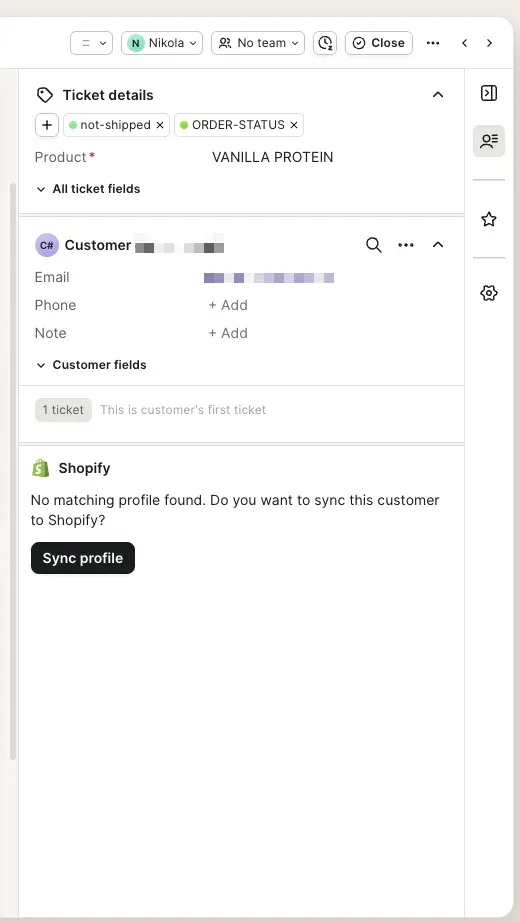
Both products can retrieve customer and Shopify order context after the relevant identity checks. Commslayer uses that context for its built-in order and subscription actions. Gorgias AI Agent can use Shopify order information, and Shopping Assistant can use current-session cart contents, browsing activity, current page, and purchase history when available.
That does not mean every channel receives the same fields. It also does not restore the former Gorgias live-cart view for human agents.
What actions can each AI agent take?
Both products can take meaningful Shopify actions. Commslayer’s settings list more predefined, customer-visible AI actions that this comparison verified, plus custom API actions. Gorgias provides documented Shopify and connected-app actions plus custom actions. A predefined native action, a connected-integration action, and a custom API workflow are not interchangeable.
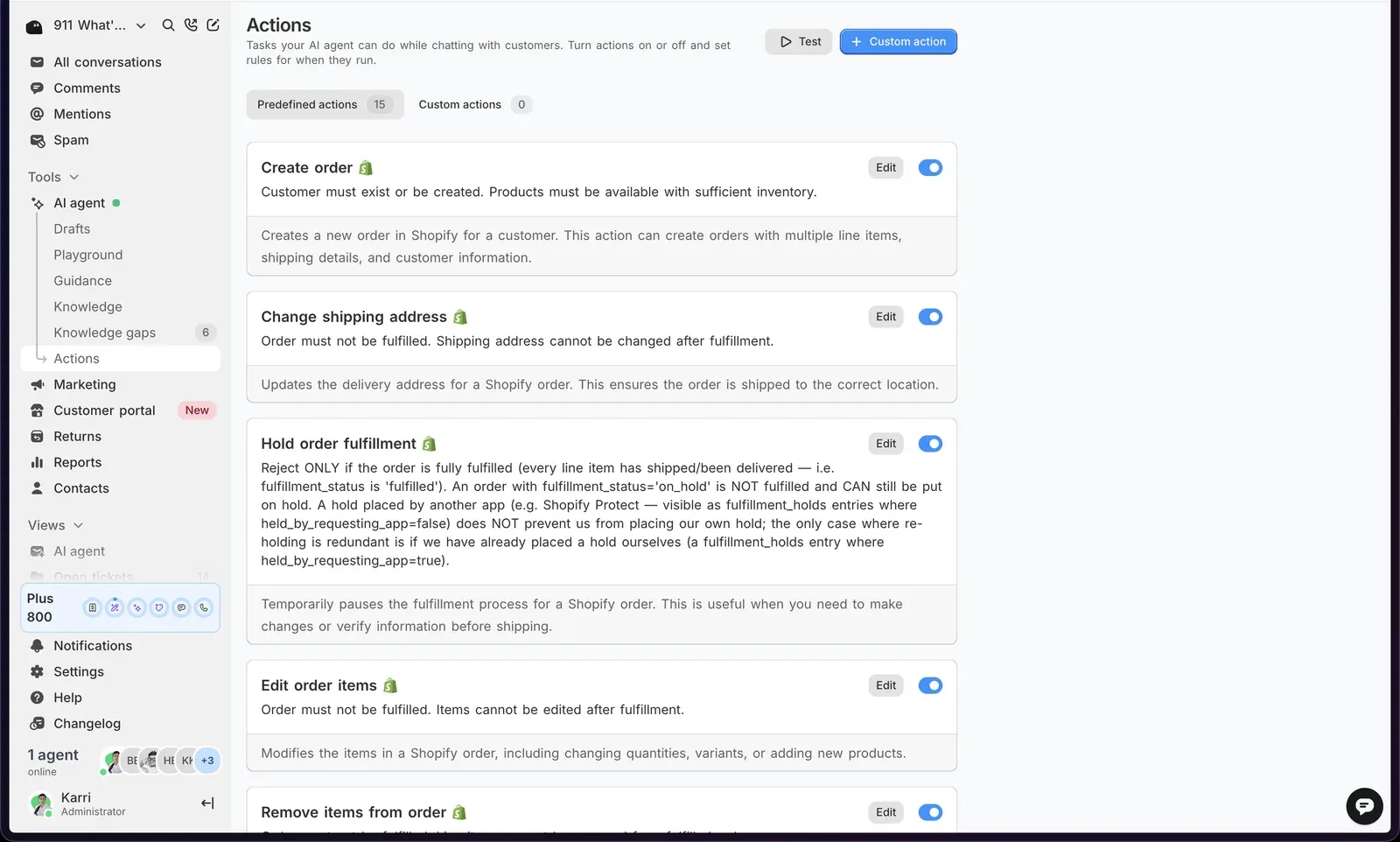
Which Shopify order actions are prebuilt?
Commslayer exposes ten predefined Shopify actions in AI Agent settings. Gorgias confirms several core Shopify actions.
| Customer-visible action | Commslayer | Gorgias | Qualification |
|---|---|---|---|
| Create order | Prebuilt | Not verified as native* | |
| Cancel order | Prebuilt | Confirmed native | Gorgias cancellation includes a full refund |
| Reship order for free | Prebuilt | Confirmed native | Merchant eligibility rules should constrain both |
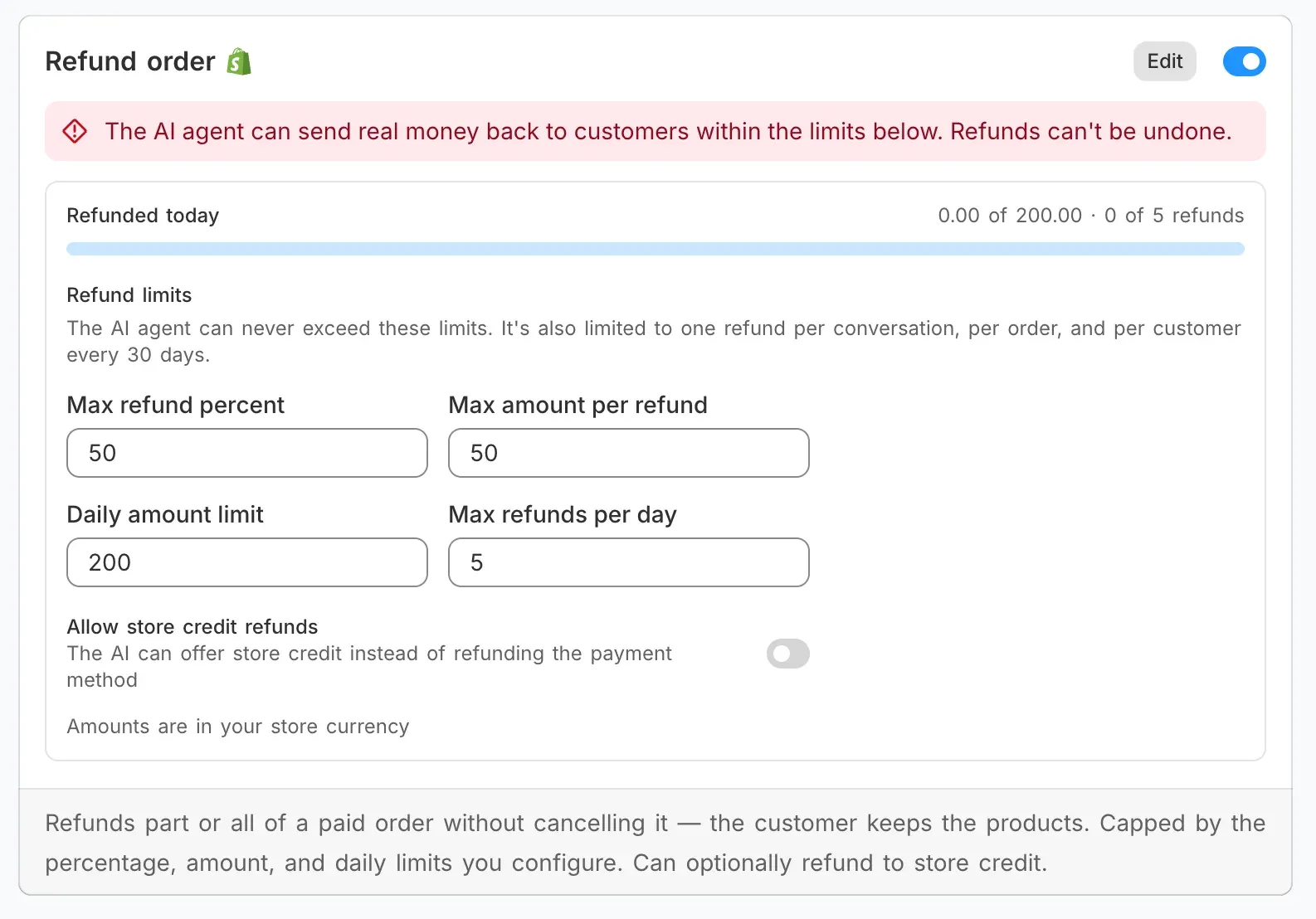
| Refund order | Prebuilt standalone action | No native standalone equivalent found; refund steps exist in the builder | Gorgias refunds inside cancellation and item-change flows |
| Hold order fulfillment | Prebuilt | Builder step, assemble yourself | |
| Remove items from order | Prebuilt | Confirmed native | Both can restock and apply merchant conditions |
| Tag Shopify order | Prebuilt | Builder step, assemble yourself | |
| Change shipping address | Prebuilt | Confirmed native | Best limited to eligible unfulfilled orders |
| Edit order items | Prebuilt | Confirmed native for remove and replace | Gorgias hands over if a replacement costs more |
| Update marketing consent | Prebuilt | Not verified as native* |
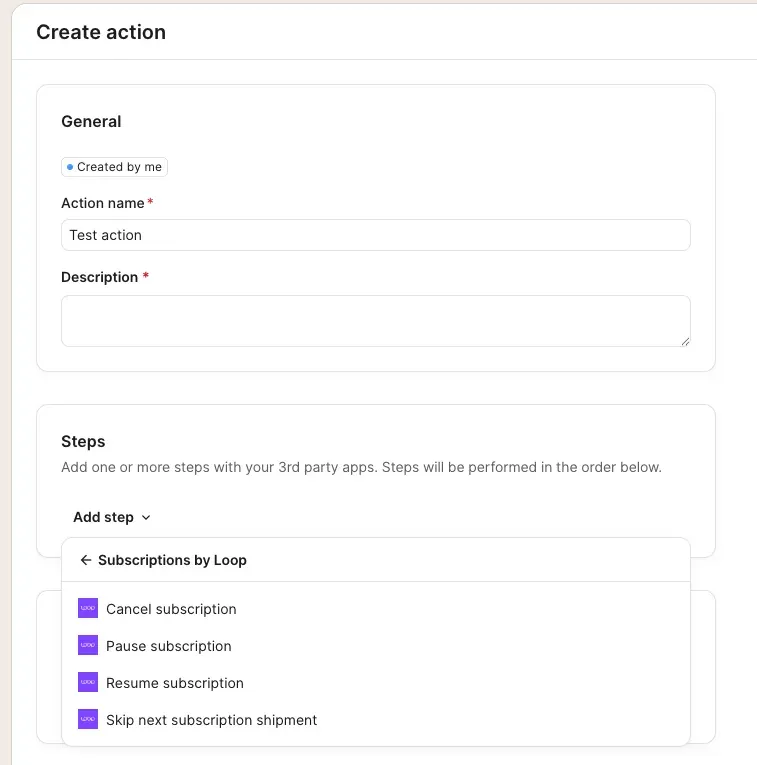
*Commslayer cells are predefined guarded action cards in AI Agent settings. Gorgias offers native Shopify steps that merchants assemble into actions in its builder, shown below. The asterisk marks actions found in neither Gorgias’s documented native actions nor the builder’s visible step list; these may be buildable as a custom HTTP action, so test permissions, authentication, required inputs, confirmation, and failure recovery before relying on it.
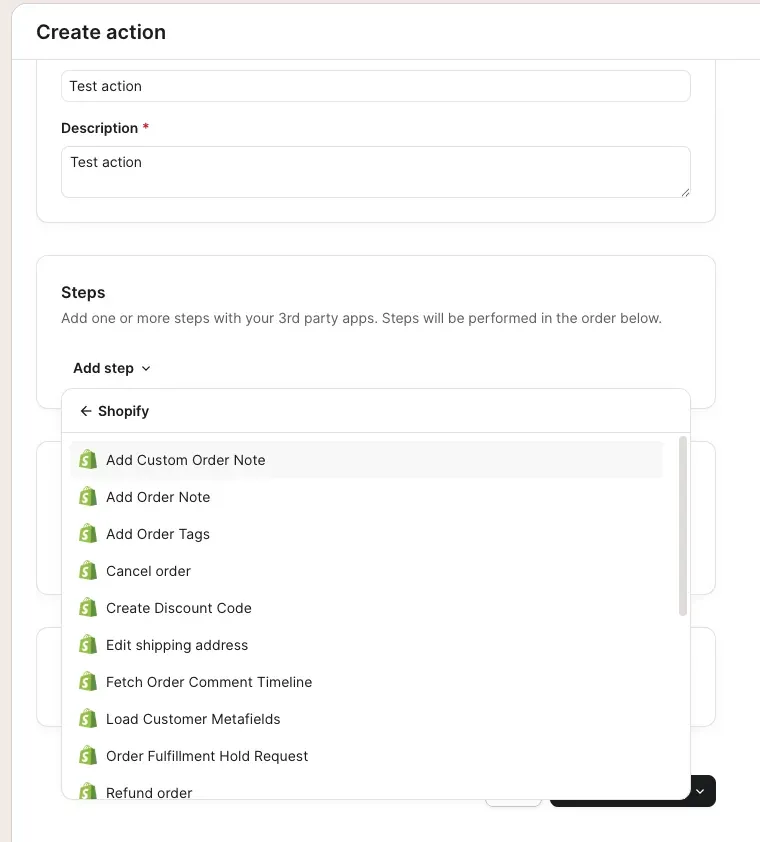
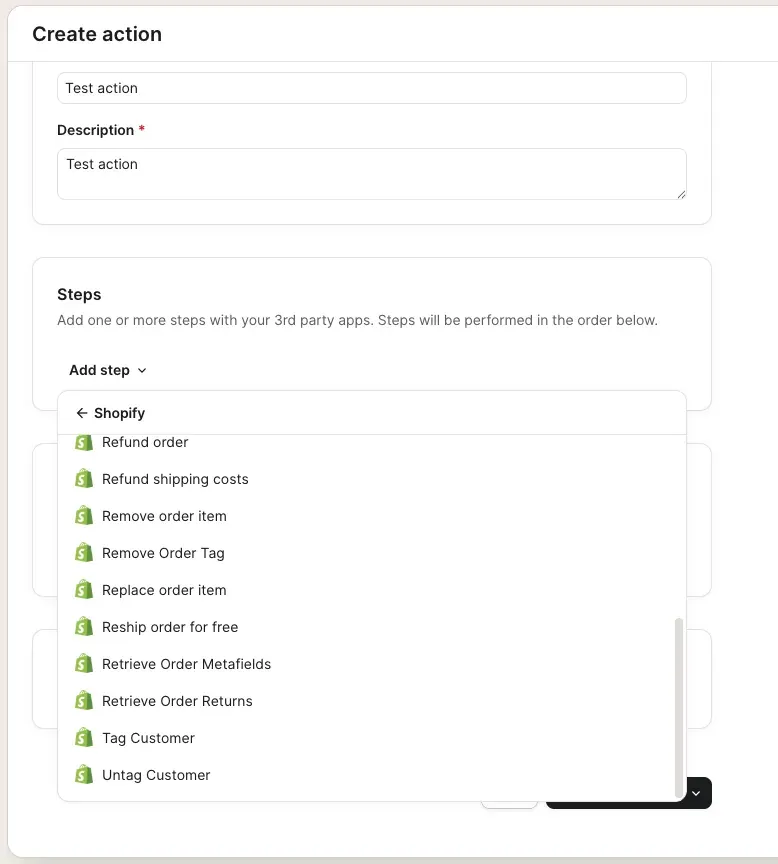
Gorgias’s documented native order actions include cancellation, shipping-address edits, item removal or replacement, free reshipment, and adding an order note inside an action. Its Shopify order-action documentation explains where refunds occur inside those flows.
A standalone refund answers a different customer request: the customer keeps the order and gets money back. Gorgias can issue refunds inside cancellation, removal, and lower-priced replacement flows. We did not find a native standalone AI action for granting a partial or full refund while the customer keeps the order. Commslayer provides this as a guarded standalone action. It is available to customers with merchant-controlled percentage, per-refund amount, daily value, daily count, and store-credit guardrails.
Commslayer also includes Create new conversation. We did not verify a native Gorgias equivalent; it may be buildable as a custom action.
Which subscription actions are prebuilt?
Commslayer exposes 20 predefined subscription actions across six platforms. They require the relevant connected subscription integration, not a higher Commslayer plan. Gorgias has confirmed native actions for Recharge, Loop, and Skio; Appstle, Stay AI, and Kaching were not verified as native AI Agent integrations in the current action index, so a custom action remains possible.
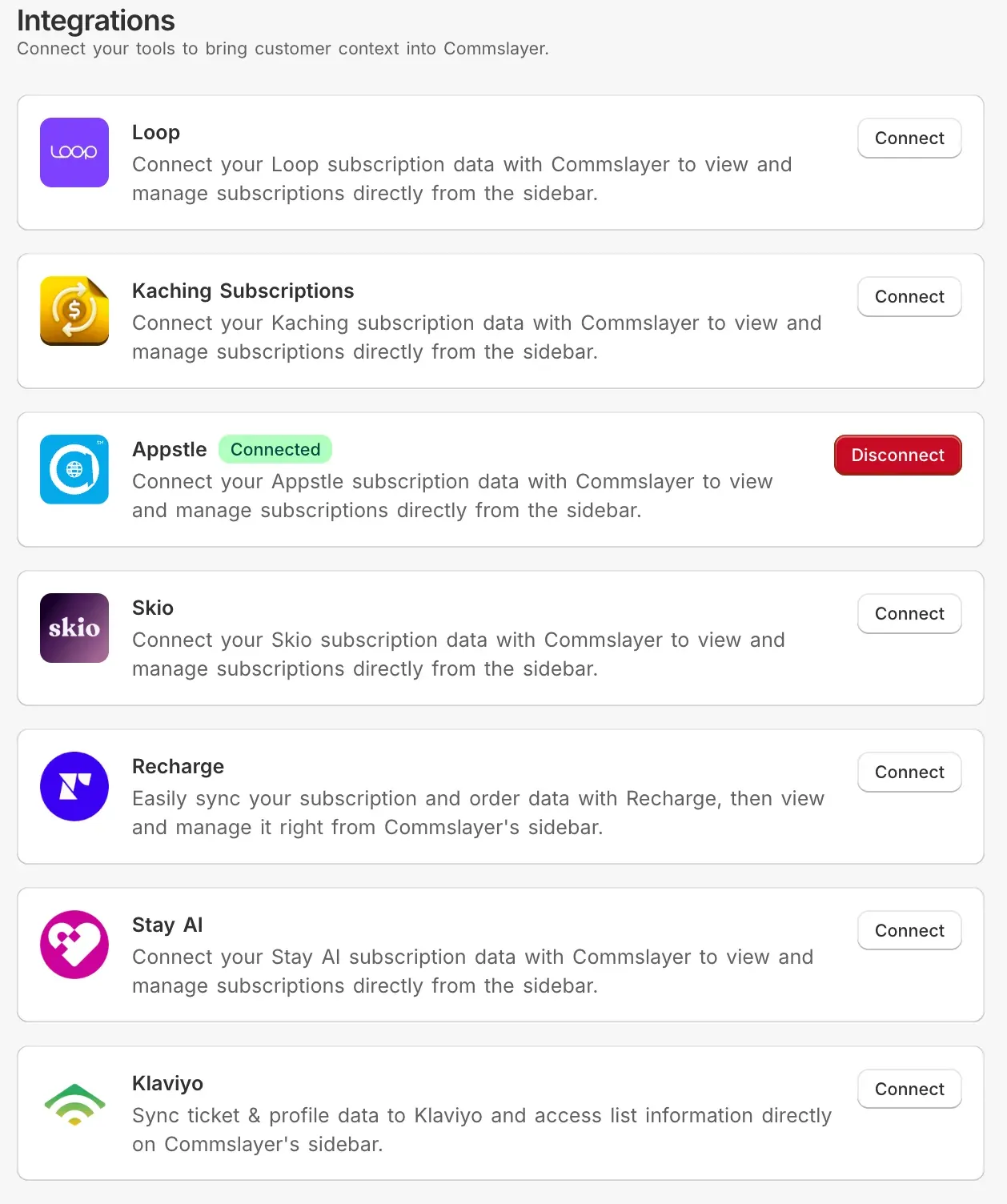
| Platform | Commslayer customer-visible actions | Gorgias classification |
|---|---|---|
| Recharge | Cancel subscription; Delay order | Confirmed through connected Recharge for cancel and skip next shipment; a chosen-date delay was not verified |
| Loop | Cancel subscription; Reactivate subscription; Reschedule subscription | Confirmed through connected Loop for cancel, skip, pause, and resume; a dated reschedule was not verified |
| Skio | Cancel subscription; Pause subscription; Reschedule subscription | Confirmed through connected Skio for cancel and skip; pause and dated reschedule were not verified as native equivalents |
| Appstle | Cancel subscription; Pause subscription; Reschedule subscription; Skip next order | Not verified as native* |
| Stay AI | Cancel subscription; Pause subscription; Unpause subscription; Reactivate subscription; Skip next order | Not verified as native* |
| Kaching | Cancel subscription; Pause subscription; Resume subscription | Not verified as native* |
*May be buildable as a custom HTTP action. Test permissions, authentication, required inputs, confirmation, and failure recovery before relying on it.
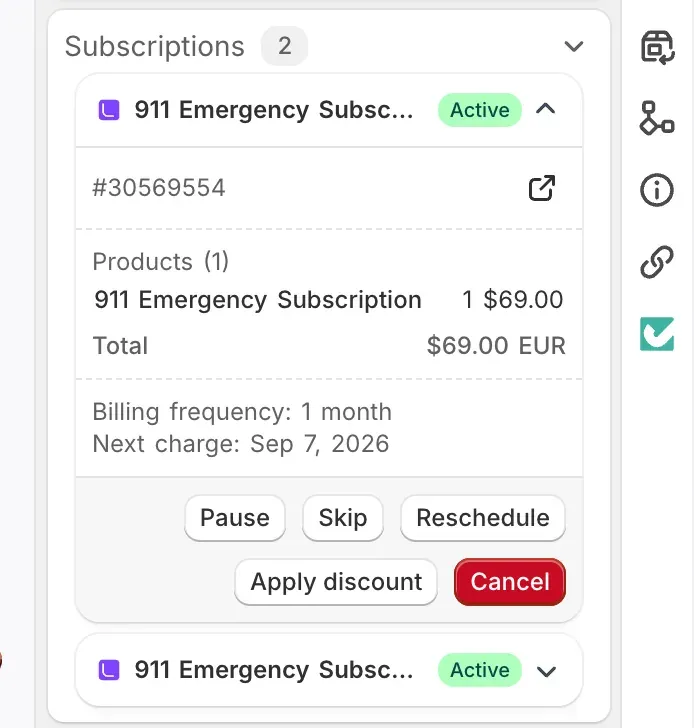
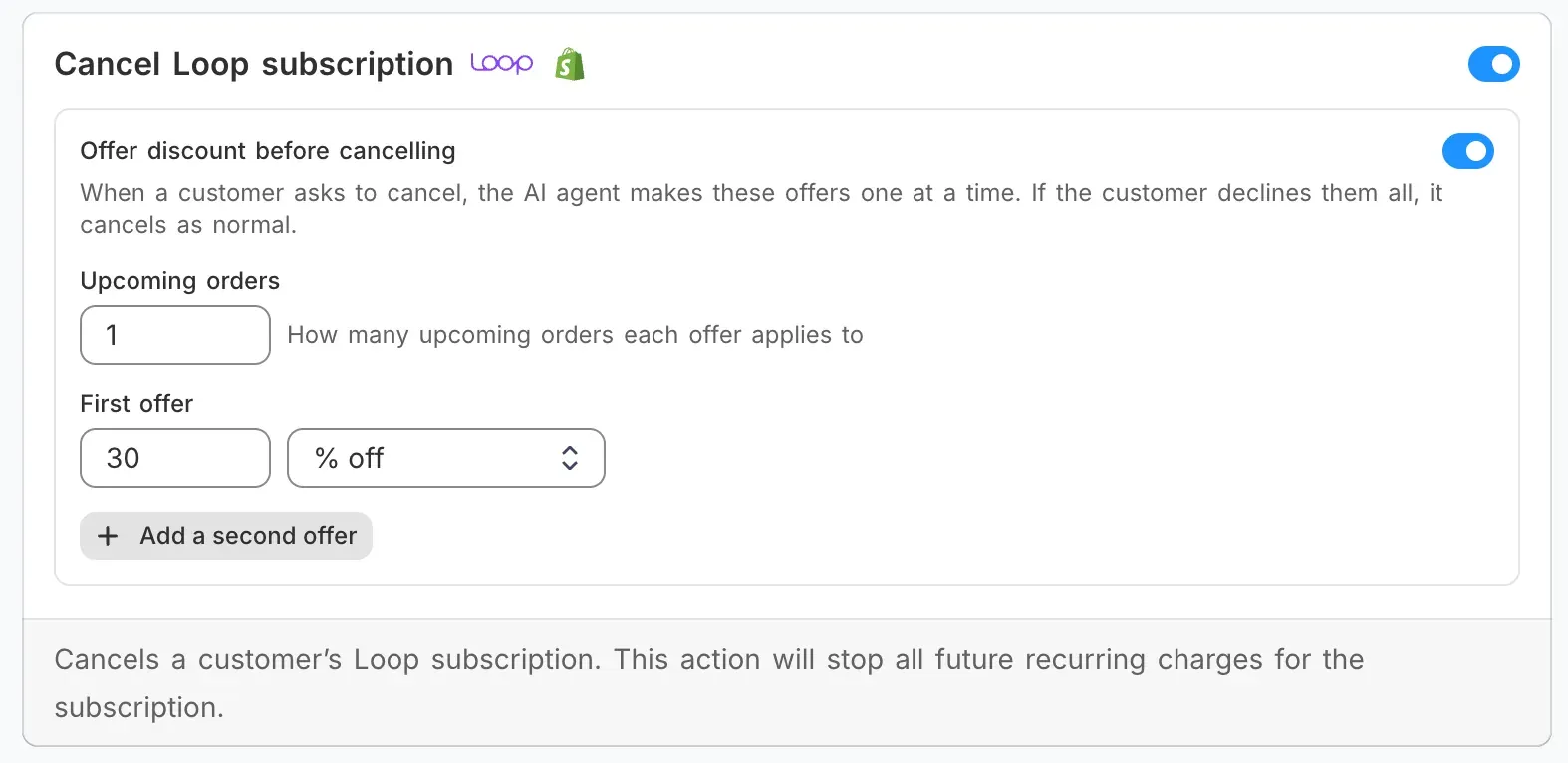
The Loop retention discount is an option inside Commslayer’s Cancel Loop subscription action, not a separate action card.
Gorgias’s current first-party documentation confirms Recharge cancel and skip, Loop skip, cancel, pause, and resume, and Skio cancel and skip. Its documented Recharge, Loop, and Skio actions hand over when the shopper has multiple subscriptions in the applicable flow.
How do custom API actions compare?
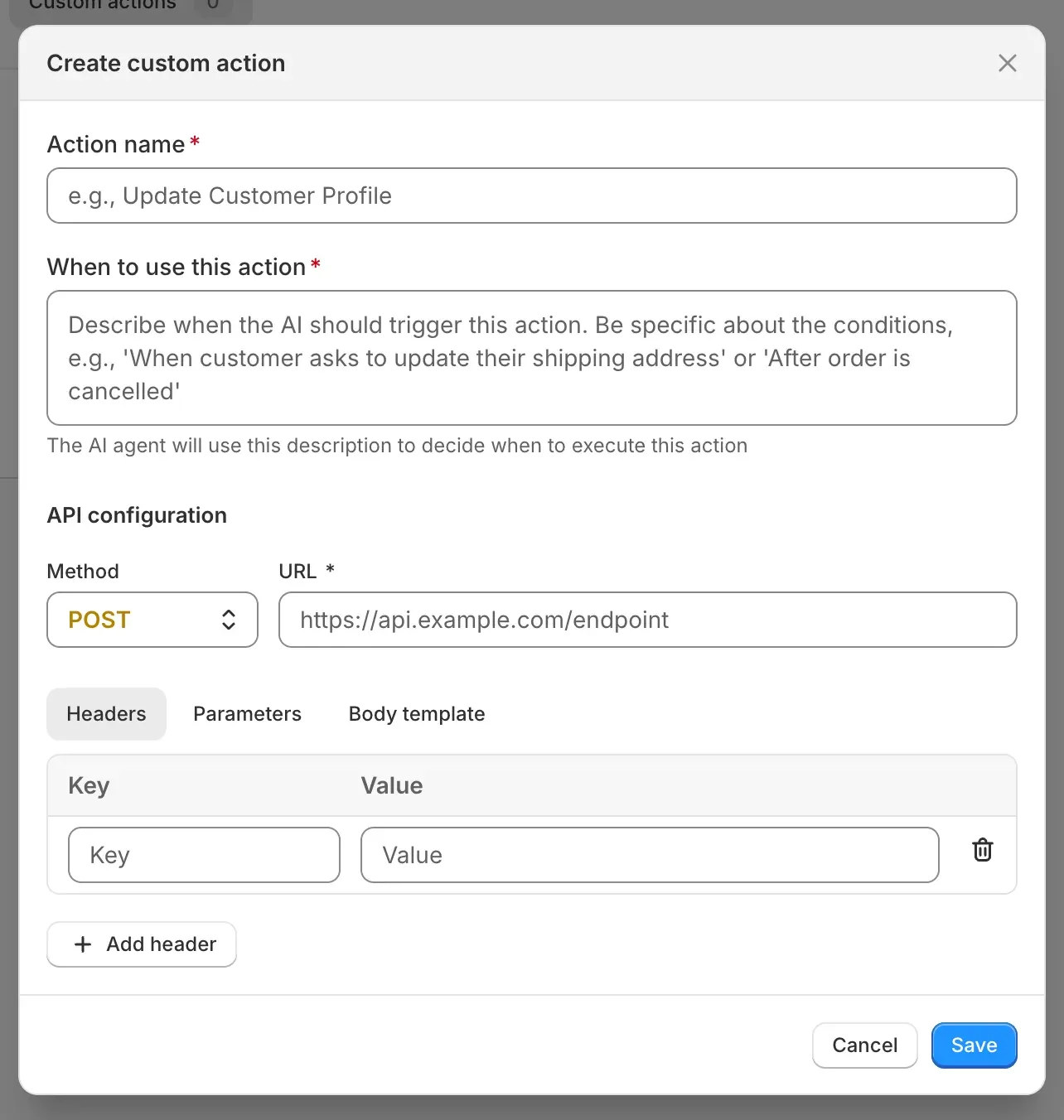
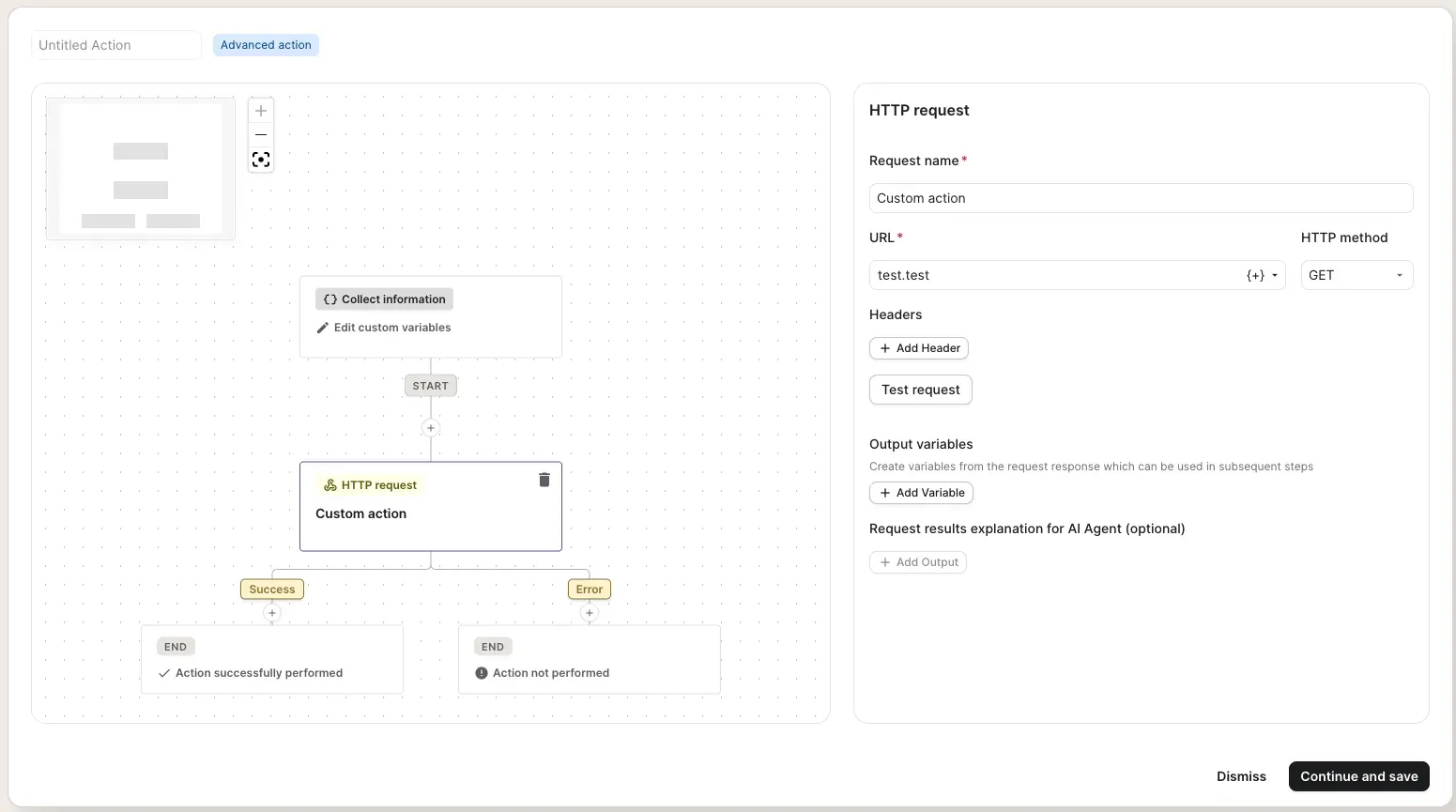
Commslayer supports authenticated REST custom actions for merchant-specific workflows. Gorgias supports a visual multi-step action builder with connected-app steps, variables, conditions, shopper confirmation, HTTP requests, branching, and logs. Gorgias suits a CX administrator who wants to configure those controls in the helpdesk. When the required Shopify or subscription operation is already predefined in Commslayer, no custom action is needed.
Which handles Shopify orders, carts, and checkout better?
Both products touch Shopify orders on three separate surfaces, and the comparison keeps them apart: what the AI Agent can execute autonomously, what a human agent can do from the helpdesk, and what the customer can do self-service. Commslayer covers more verified post-purchase AI Agent actions in this comparison, including order editing and creating a new order or checkout path, and adds customer self-service order editing. Gorgias provides established helpdesk-side Shopify controls for human agents and documents richer pre-purchase cart context through Shopping Assistant, an AI sales surface. Teams should compare whether post-purchase action breadth or live-cart sales assistance matters more to their workflow.
Can human agents and AI see the customer’s live cart?
Gorgias Shopping Assistant, an AI surface rather than a helpdesk feature, can use the shopper’s current cart for pre-purchase assistance. Its recommendation logic can also use browsing activity, the current page, and purchase history. For human agents in the helpdesk, the older live-cart view has been removed from the ticket sidebar; a July 2026 Shopify App Store review and Gorgias’s public response both record the removal. Those statements can both be true because AI cart retrieval and human-agent sidebar visibility are separate product surfaces.
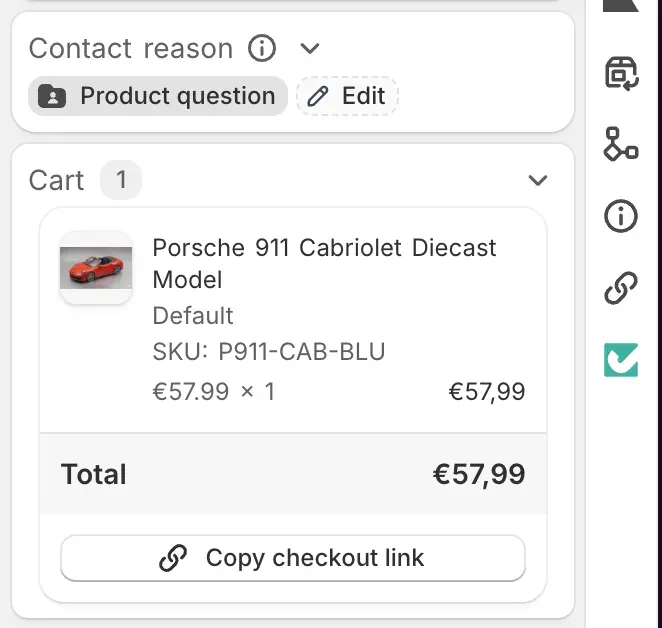
In Commslayer, the same Shopify customer and order context serves both surfaces: human agents see the shopper and relevant orders in the conversation sidebar, and the AI Agent uses that context for its enabled actions after verification. Human agents also see the visitor’s current cart contents in the conversation sidebar, with a copyable checkout link.
Which can edit orders after checkout?
Commslayer has the broader predefined post-purchase action set in this comparison, and these are AI Agent actions, enabled and guarded in AI Agent settings: cancel, reship, refund, hold fulfillment, remove items, tag the order, change the shipping address, edit order items, update marketing consent, and create a new order. Separately from the AI, Commslayer’s Shopify order-editing product gives customers merchant-controlled self-service surfaces after checkout.
Gorgias natively handles several common changes inside the support workflow: cancel, edit address, remove or replace items, reship, and add an order note. It can create discount codes, while other operations require a matched custom-action implementation. Gorgias replaces an item natively when the new item costs the same or less, refunding the difference where needed; it hands over when the replacement costs more.
The meaningful refund difference is scope. Gorgias documents refunds as an outcome of cancellation and item-change flows. Commslayer also lets AI grant a guarded standalone partial or full refund without cancelling or changing the order. Before letting either AI refund autonomously, test the tricky order types listed in the checklist near the end.
Can Commslayer replace a checkout thank-you-page order-editing app?
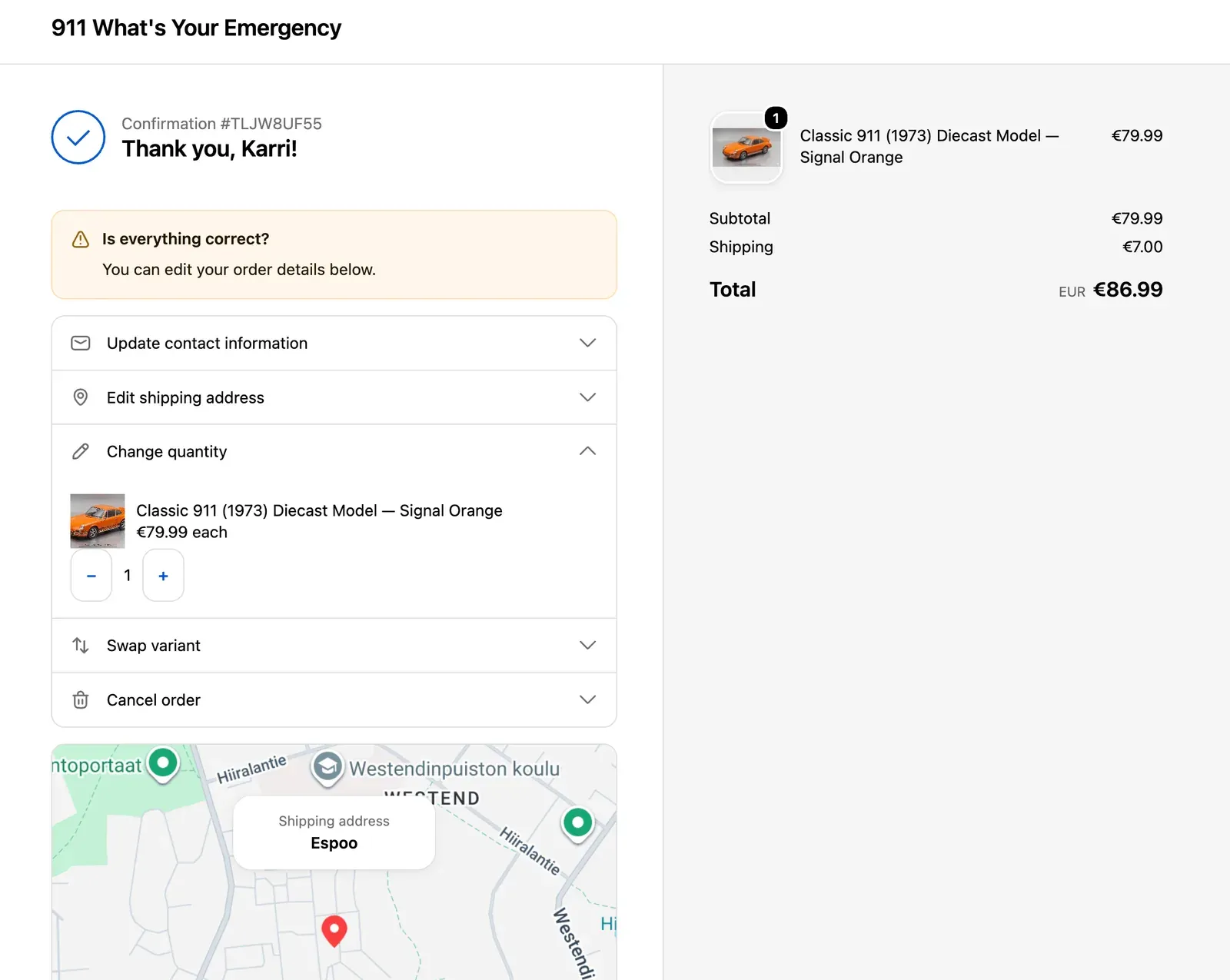
Yes. For merchants considering OrderEditing.com mainly to let shoppers correct a new Shopify order from the checkout thank-you page, Commslayer’s checkout thank-you-page editing can replace that use case. Commslayer provides the same merchant-controlled self-service in chat and on the Shopify customer-account order-status page.
Shoppers can update contact details, change the shipping address, adjust quantity or variant, or cancel the order. Each change remains subject to the merchant’s rules, available inventory, and fulfillment eligibility. These customer-facing editing surfaces are separate from the 31 settings-page AI actions counted earlier and do not add cards to that inventory.
Which is better for subscription and supplement brands?
Commslayer exposes more predefined subscription actions across more subscription platforms. Gorgias documents actions for Recharge, Loop, and Skio and has a larger overall app ecosystem. For recurring-order support, compare the exact customer requests and connected subscription apps rather than relying on a general verdict.
Supplement and subscription brands receive repetitive but financially sensitive requests: pause, skip, reschedule, reactivate, delay an upcoming order, cancel, or accept a retention offer. A useful AI Agent must do more than answer a policy question. It needs to identify the right subscription, apply the correct merchant rule, confirm the shopper’s intent, execute the change, and hand over when the situation falls outside the safe path.
Commslayer’s current settings include actions across Recharge, Loop, Skio, Appstle, Stay AI, and Kaching. That breadth is especially relevant for supplement brands whose customers ask to postpone deliveries, avoid stockpiling, or change the cadence of recurring orders. The Loop cancellation action can include a merchant-defined retention discount. Subscription actions require the relevant connected app, but they are not reserved for a higher Commslayer plan.
Gorgias documents connected-app workflows for Recharge, Loop, and Skio. These actions can cancel or skip, and Loop also supports pause and resume. Several documented flows hand over when a customer has multiple subscriptions, which is a useful guardrail but leaves that case for a human. Appstle, Stay AI, and Kaching should be treated as custom-action opportunities unless current Gorgias documentation or a correctly configured account confirms a native action.
Both vendors publish supplement-brand customer proof, and it should be read as vendor-published rather than independent evidence. Two supplement brands are public Commslayer references: Luma Nutrition and Healthletic, customer referrals published on Commslayer’s own site whose brands have also reviewed Commslayer on the Shopify App Store. Gorgias publishes a case study with Obvi, a collagen supplement brand that reports a 50% automation rate with 1.5 agents handling more than 150 tickets a day.
Can one account support multiple Shopify stores?
Yes, both products can support multiple Shopify stores, but the operating model differs. Gorgias lets administrators select and configure AI Agent by connected store. Commslayer can connect multiple Shopify stores under an account, while separate accounts can be preferable when brands need isolated knowledge, policies, users, or reporting. Validate how each product separates AI context before combining distinct brands.
Which handles translation, public comments, and support channels better?
Commslayer automates both directions of human-message translation and can moderate supported public comments with AI. Gorgias supports multilingual human support and multilingual AI replies, but its current human workflow automatically translates inbound messages and asks the agent to trigger outbound translation. Gorgias human agents can manage public comments and DMs, while its current social AI coverage is Instagram DMs and Facebook Messenger.
Which automatically translates human support messages?
Both products support native multilingual service. Commslayer’s Plus, Scale, and Enterprise plans automatically translate inbound human-support messages into the agent’s language and translate the agent’s reply back into the shopper’s language. The original text remains available for context.
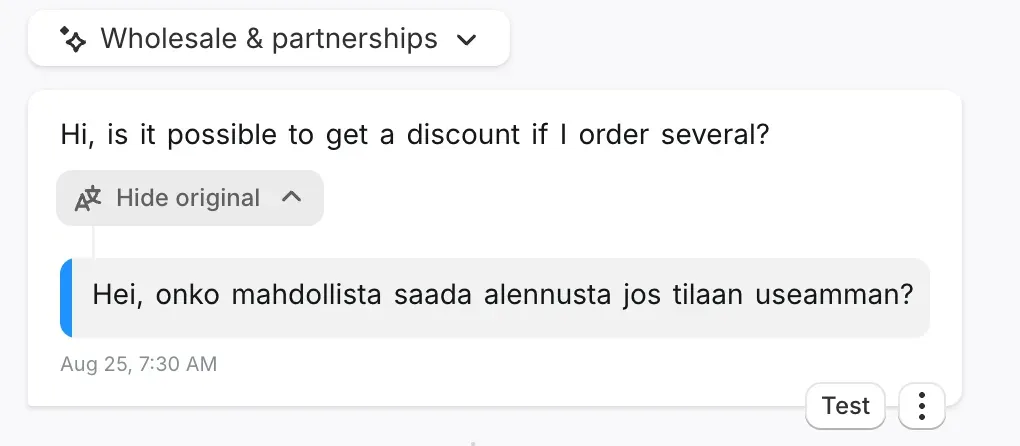
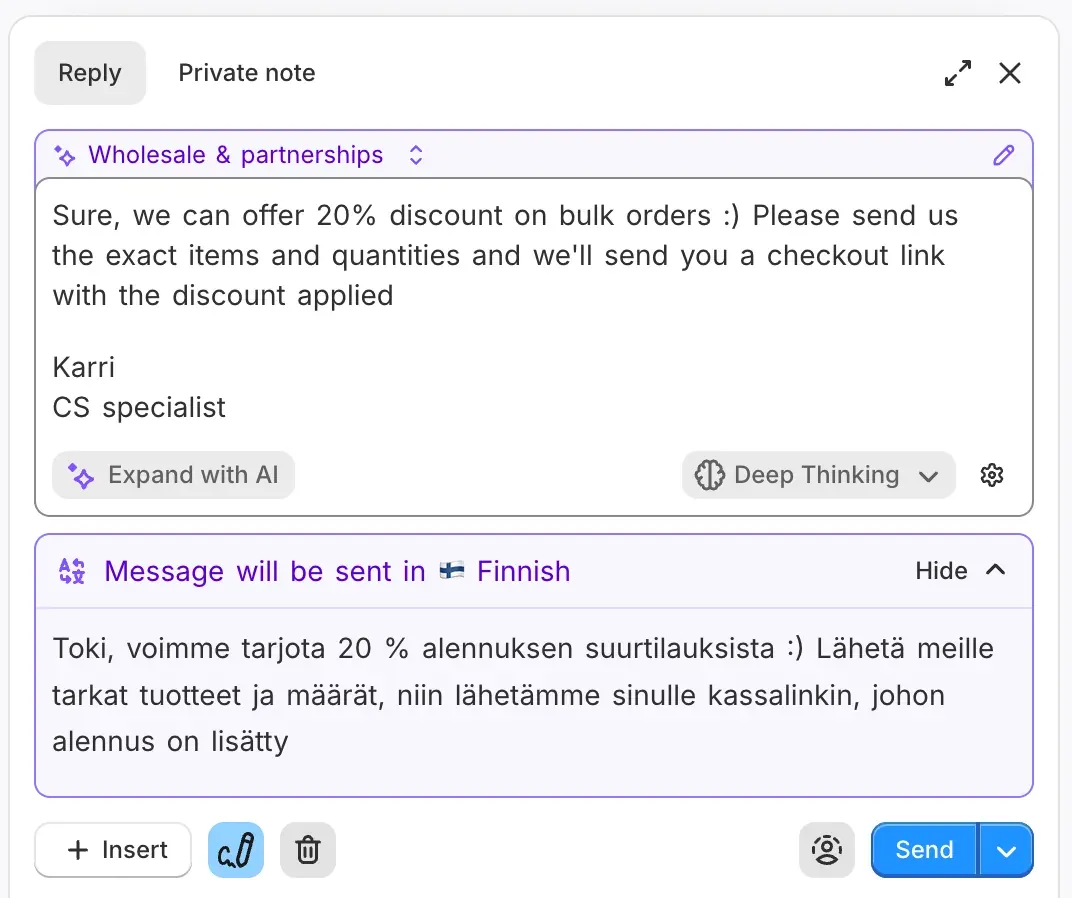
Gorgias makes native translation available on all Helpdesk plans. Its current translation workflow automatically translates incoming customer-facing messages based on the agent’s profile language. For an outbound human reply, the agent uses the translation control and selects the target language before sending. Gorgias AI Agent separately detects and replies in the shopper’s language on supported channels.
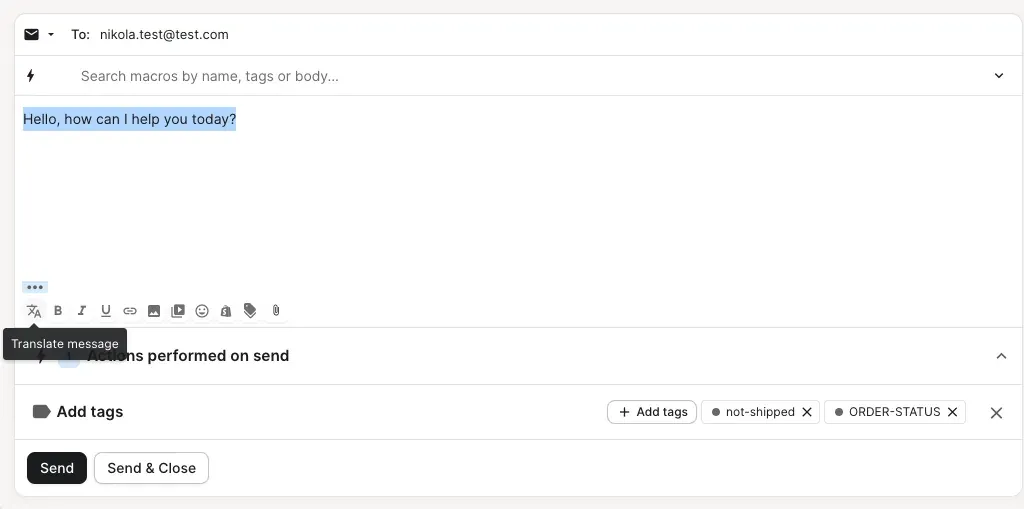
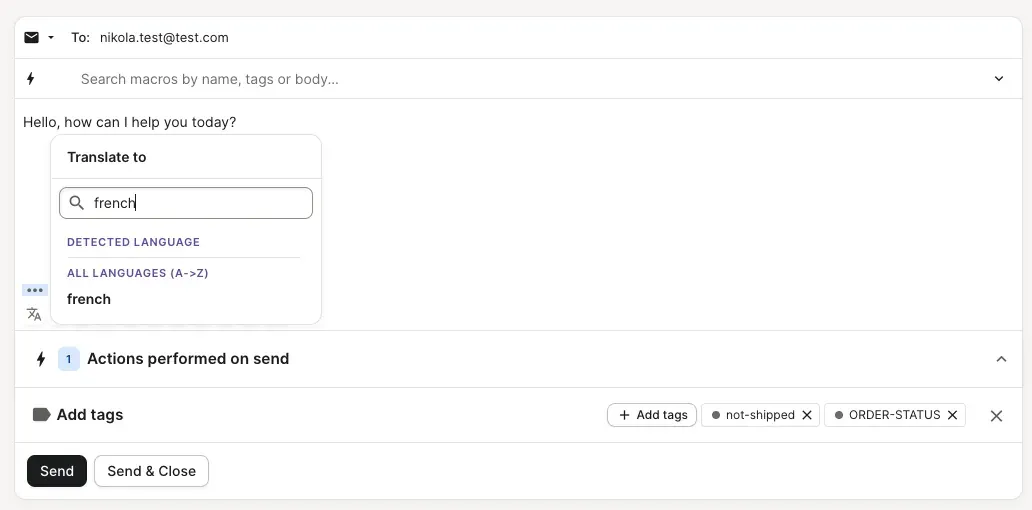
Commslayer therefore has the more automatic human-agent workflow in the current documentation. Regulated statements are still worth spot-checking in the store’s most important languages.
Which handles public social comments better?
Commslayer adds AI-assisted social media comment moderation on Facebook and Instagram. Every supported comment is brought into the inbox and automatically checked by AI moderation, which hides content that matches merchant rules and lets agents review or undo the result. Every comment also gets a ready AI draft reply an agent can send as is or edit. The AI does not send public replies itself, because an AI that answers every comment can look unnatural and create platform-health risk. Public comments do not count as Commslayer billable conversations under the published pricing model.
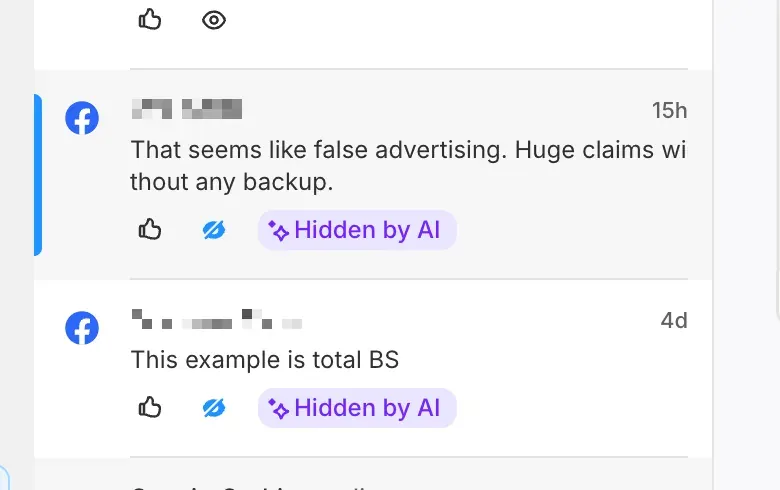
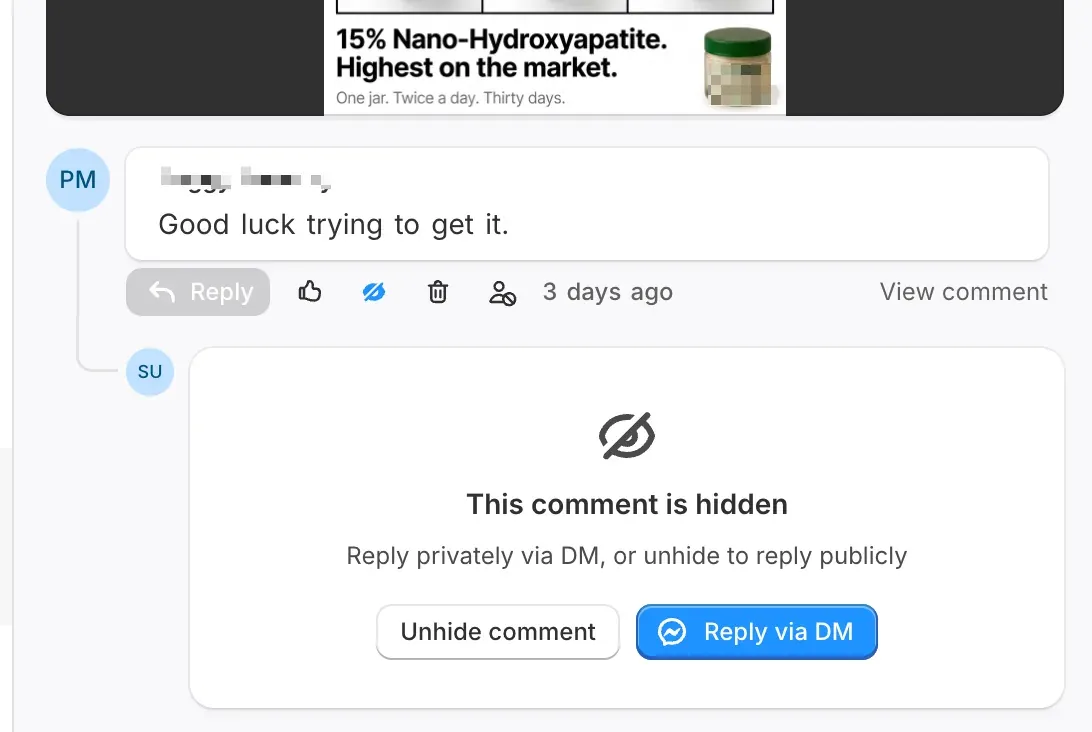
Gorgias is capable for human-led social support. Its Facebook and Instagram integration brings posts, comments, mentions, Messenger messages, and Instagram DMs into the helpdesk. Human agents can hide a comment, like or unlike it, reply publicly, or send a private reply through Messenger or Instagram DM. Gorgias AI Agent currently answers Instagram DMs and Facebook Messenger. Gorgias states that this AI does not moderate or reply to public posts, mentions, or comments.
Which support channels are available?
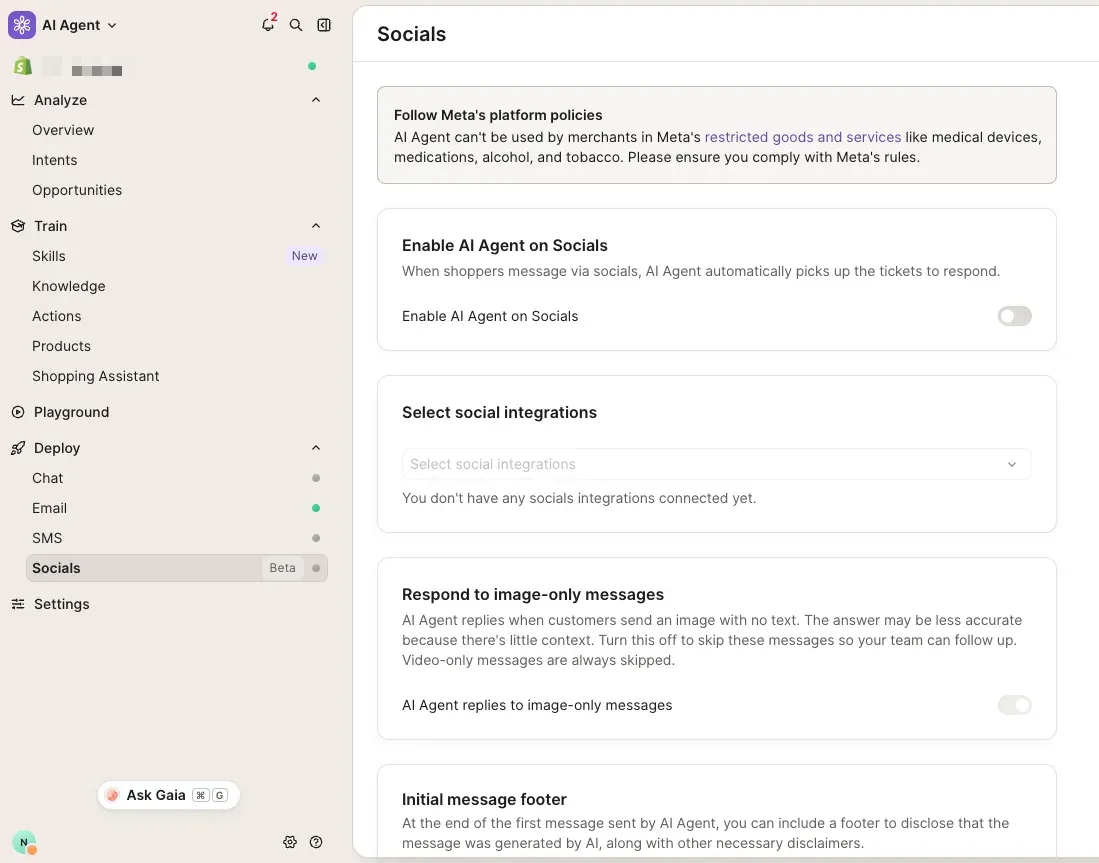
Both products cover the core Shopify channels, but the AI boundary differs by channel. A connected inbox does not mean the AI can reply there, so human and AI availability are listed separately.
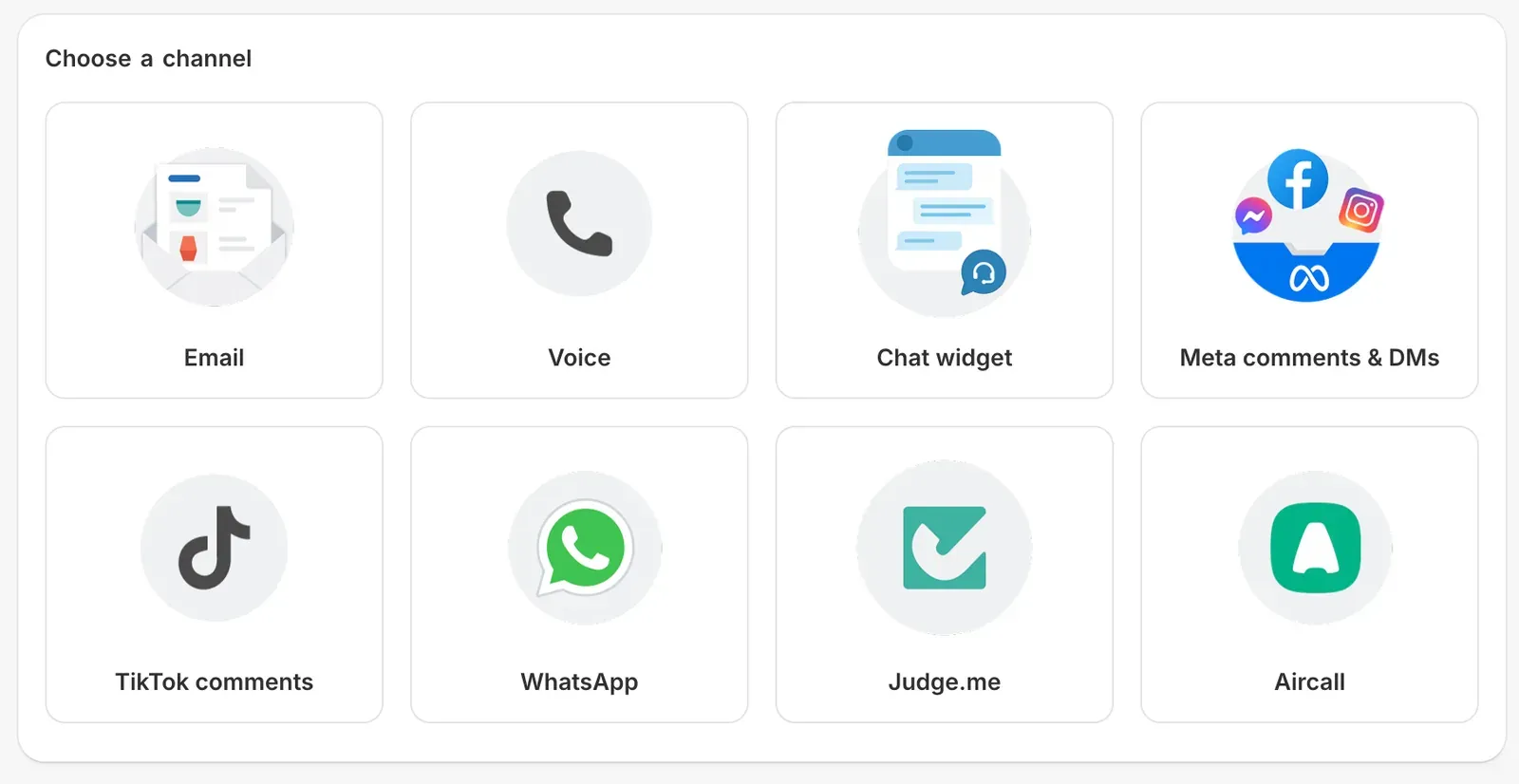
| Channel | Commslayer human | Commslayer AI | Gorgias human | Gorgias AI |
|---|---|---|---|---|
| ✓ | ✓ | ✓ | ✓ | |
| Live chat | ✓ | ✓ | ✓ | ✓ |
| ✓ When connected | ✓ When connected | ✓ When connected | — | |
| Facebook Messenger and Instagram DMs | ✓ When connected | ✓ On supported connected channels | ✓ When connected | ✓ |
| TikTok comments | ✓ When connected | — | — | — |
| Public Facebook and Instagram comments | ✓ | ~ Automatic moderation and ready AI drafts; human sends replies | ✓ | ✗ No moderation or replies in the current social AI |
| SMS | ✗ | ✗ | ✓ Separate add-on | ✓ When the SMS add-on is configured |
| Human phone | ✓ Native | ✗ Voice AI coming soon | ✓ Native Voice add-on | — No native Voice AI in current first-party evidence |
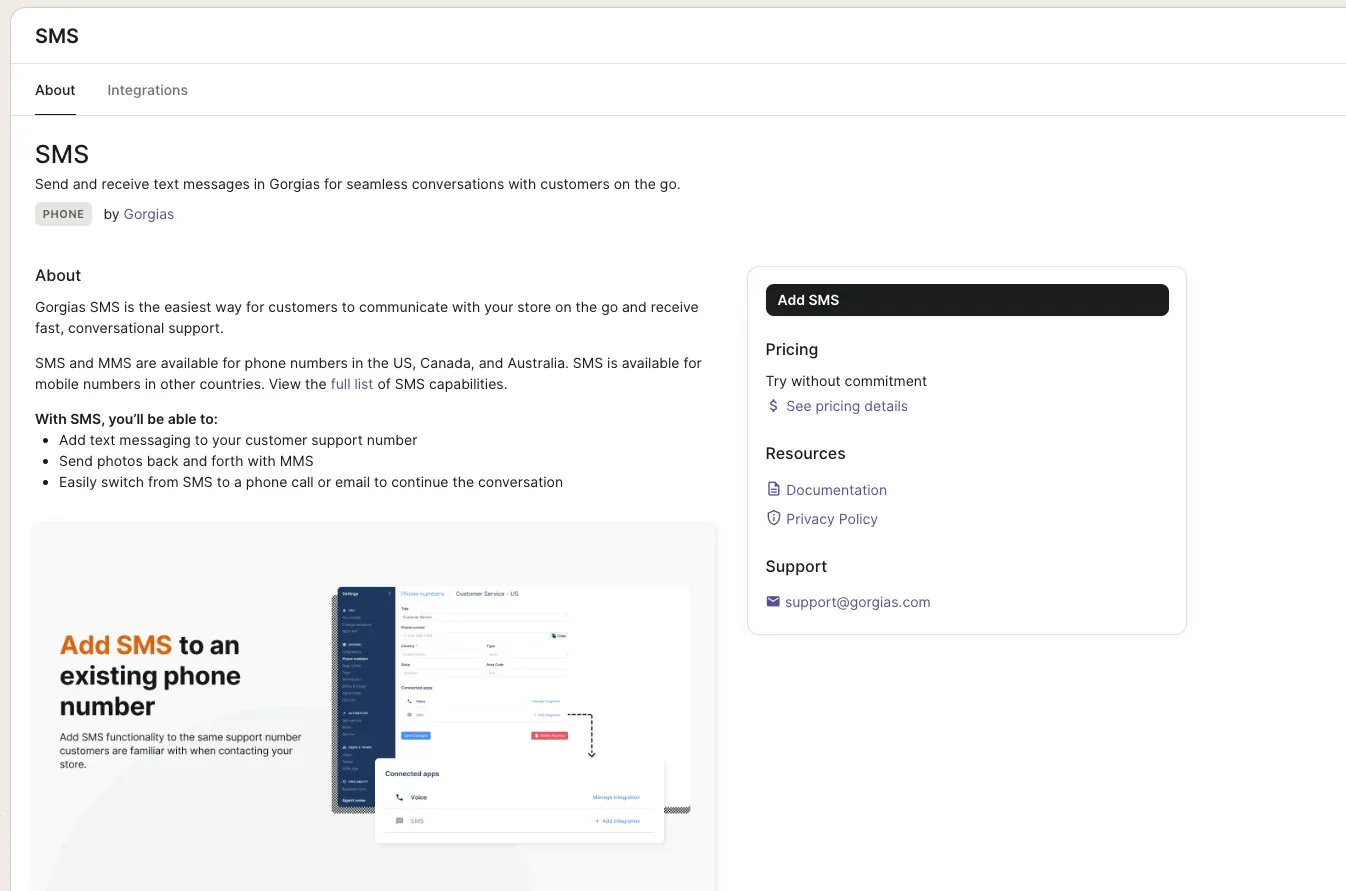
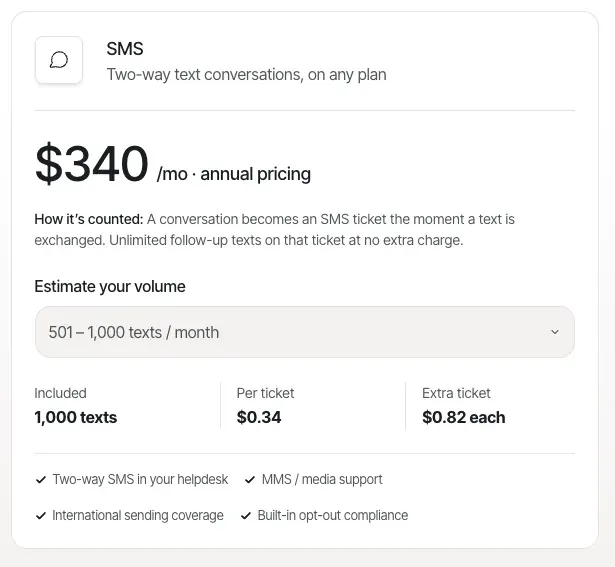
Availability can depend on region, platform policy, store type, and integration state. The checklist near the end covers testing each channel in both products.
Which has more SEO-friendly Shopify help-center pages?
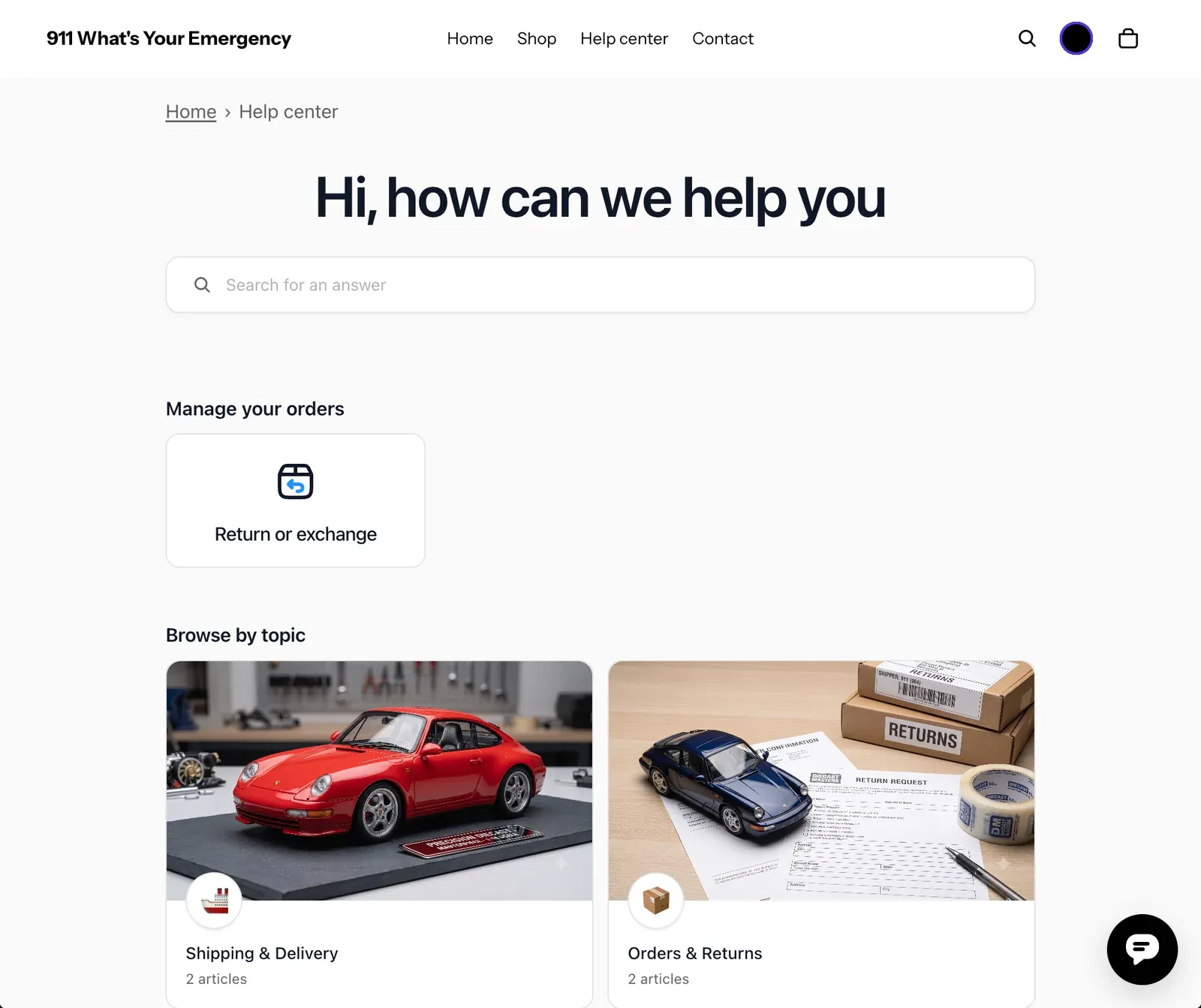
Commslayer has the more storefront-native Shopify publishing model because it serves article content on the Shopify store domain inside the existing theme. Gorgias offers automatic embedding for non-headless Shopify stores, manual HTML embedding, and a standalone hosted help center. The current evidence does not prove that Commslayer is more crawlable or ranks better than Gorgias, so neither product should be declared an SEO winner without a matched render test.
Commslayer’s customer portal and help-center delivery returns help content for Shopify to render as part of the storefront. Buyers get a store-domain experience that inherits the merchant’s theme instead of relying only on a separate help-center property.
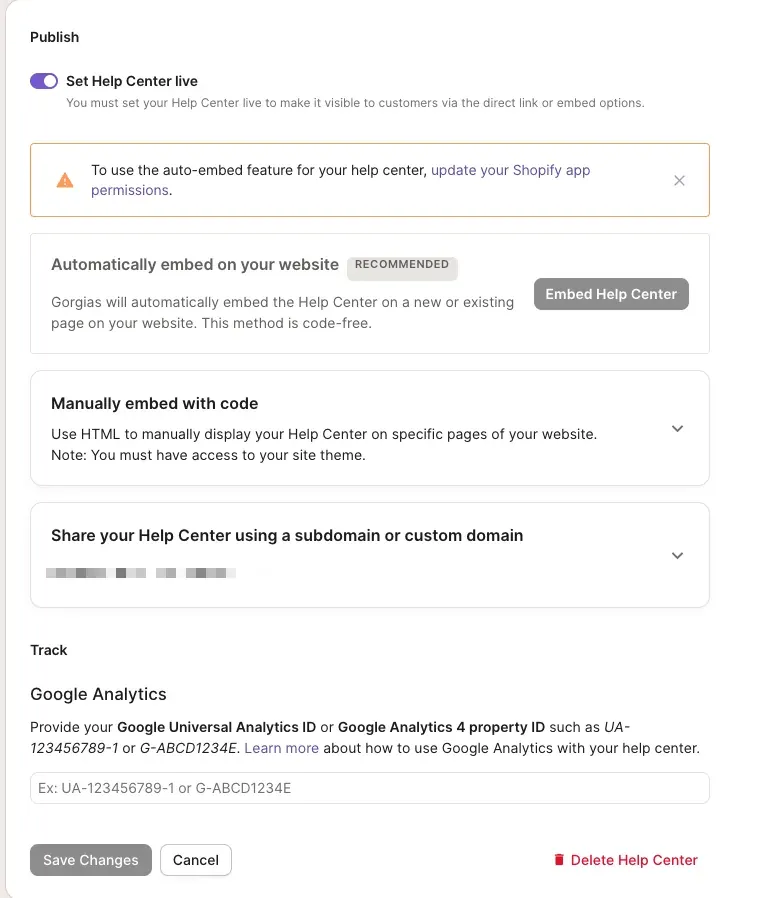
Gorgias supports an automatic Shopify embed, manual HTML embedding for other placements and headless stores, and a standalone hosted help center. One Gorgias Help Center can be automatically embedded into one Shopify store. A merchant needs to duplicate the Help Center to auto-embed it into additional stores. These are flexible publication options, but the embedded content still originates from the Gorgias help-center service.
Which has better native phone support?
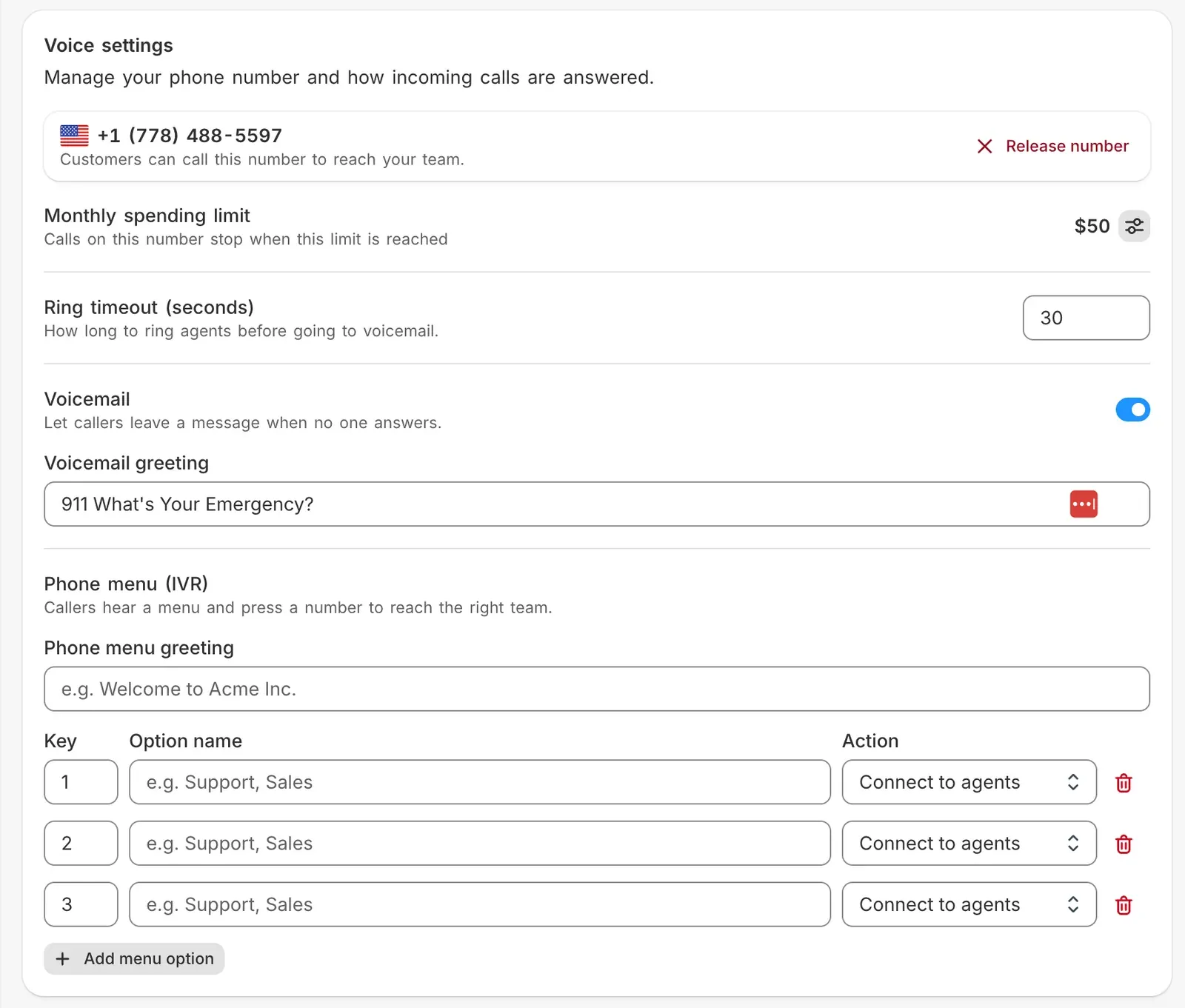
Both Commslayer and Gorgias have native phone support for Shopify. Both support inbound and outbound calls, IVR, recordings, transcripts, AI call summaries, and reporting. Gorgias documents more detail for transfers and callbacks. The more affordable product depends on call length, direction, country, and the current rate table.
What would 500 five-minute US calls cost?
The matched scenario uses one US phone number, 500 connected calls per month, five minutes per connected call, and 2,500 connected minutes. Gorgias bills Voice by ticket with no per-minute charge, while Commslayer charges $5 per month per phone number plus per-minute usage, with no minutes included in any plan.
| Cost component | Commslayer | Gorgias |
|---|---|---|
| Billing unit | One US number at $5/mo + 2,500 connected minutes billed per minute (no minutes included) | 500 Voice tickets, assuming one connected call per ticket; billed per ticket, with no per-minute charge |
| Current price | $5 number fee + 2,500 × $0.059 per inbound minute = $152.50, assuming all calls are inbound (US rates, August 25, 2026) | $250/mo at the 251 to 500 calls tier, which includes all 500 calls, so the scenario total is $250 regardless of call length |
| Overage | Usage is billed per minute with no bundled allowance: $0.059 per inbound and $0.074 per outbound US minute | $1.00 per extra Voice ticket beyond the 500 included; call length does not change the price |
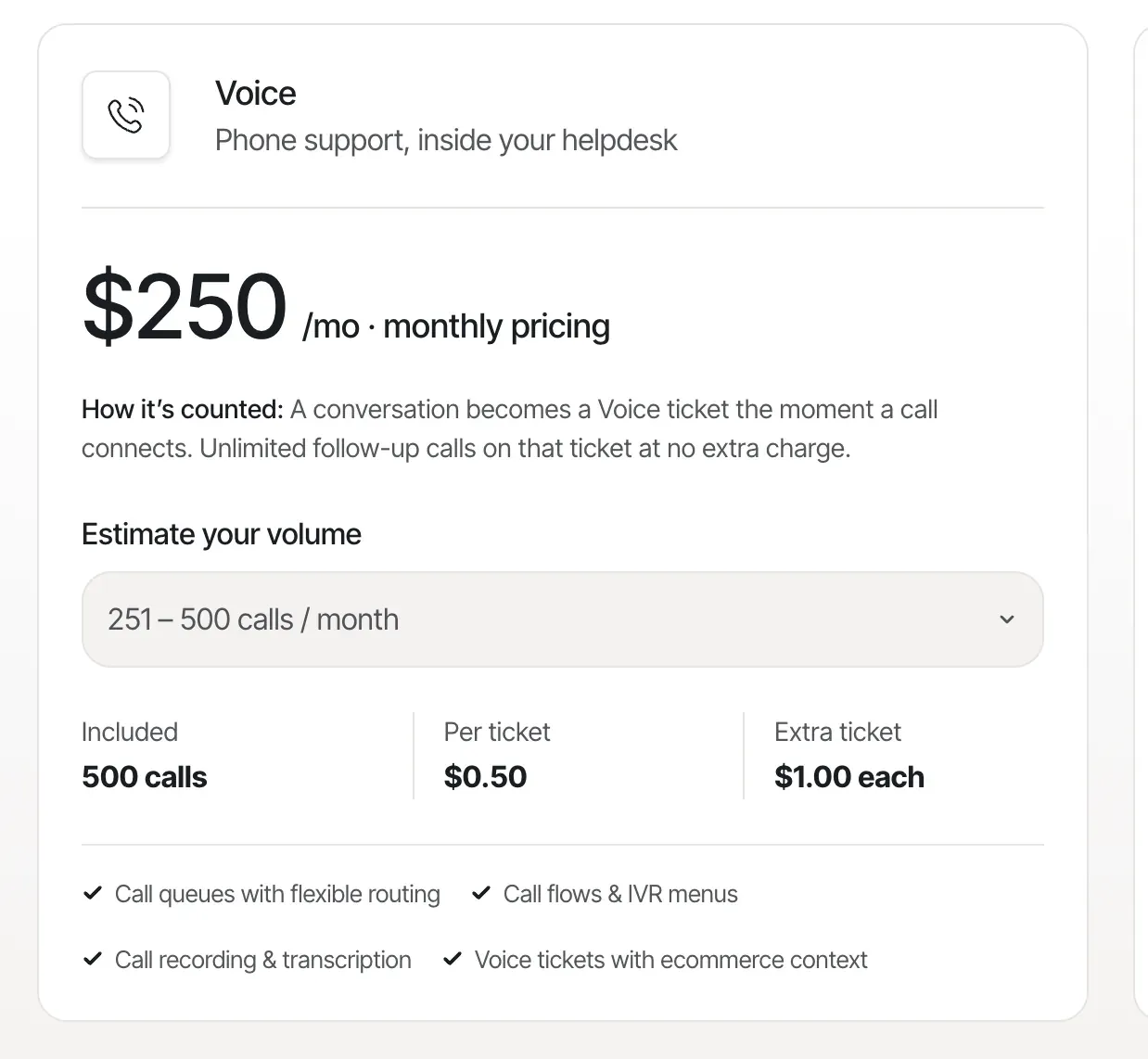
Gorgias’s current Voice documentation confirms native call handling, while its call-flow and IVR documentation covers routing details.
How do the phone features compare?
Both products cover the core phone workflow. Commslayer’s current product includes an IVR phone menu with team routing and a Voice report. Gorgias publishes more detail about transfers and callbacks.
| Capability | Commslayer human phone | Gorgias Voice |
|---|---|---|
| Inbound and outbound calling | ✓ | ✓ |
| Routing and queues | ✓ IVR team routing | ✓ |
| IVR or call flows | ✓ | ✓ |
| Transfers | — | ✓ |
| Callbacks | — | ✓ |
| Recordings | ✓ | ✓ |
| Transcripts | ✓ | ✓ |
| AI summaries | ✓ | ✓ Call and voicemail summaries and transcripts |
| Reporting | ✓ Inbound, outbound, answered, missed, voicemail, average wait, and average talk time | ✓ |
| Geographic availability and porting | Varies by country | Varies by country and plan |
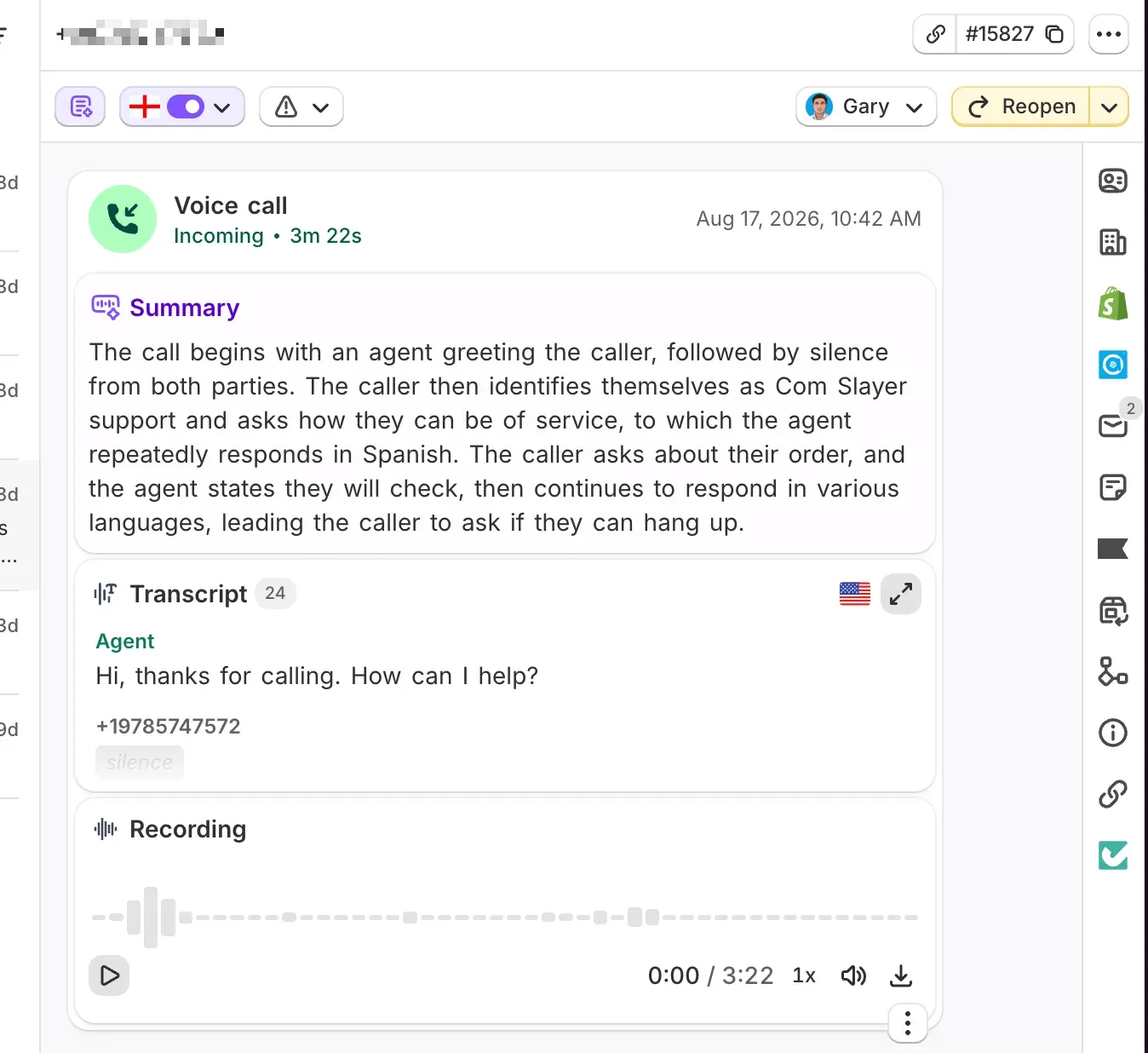
Do either offer Voice AI?
Neither product should receive credit for native Voice AI based only on human phone or a third-party integration. Commslayer’s public site marks Voice AI as coming soon. No native Gorgias Voice AI was confirmed in the current first-party evidence. Both have native human phone today, which is the capability compared above.
Which has better integrations, API, and MCP?
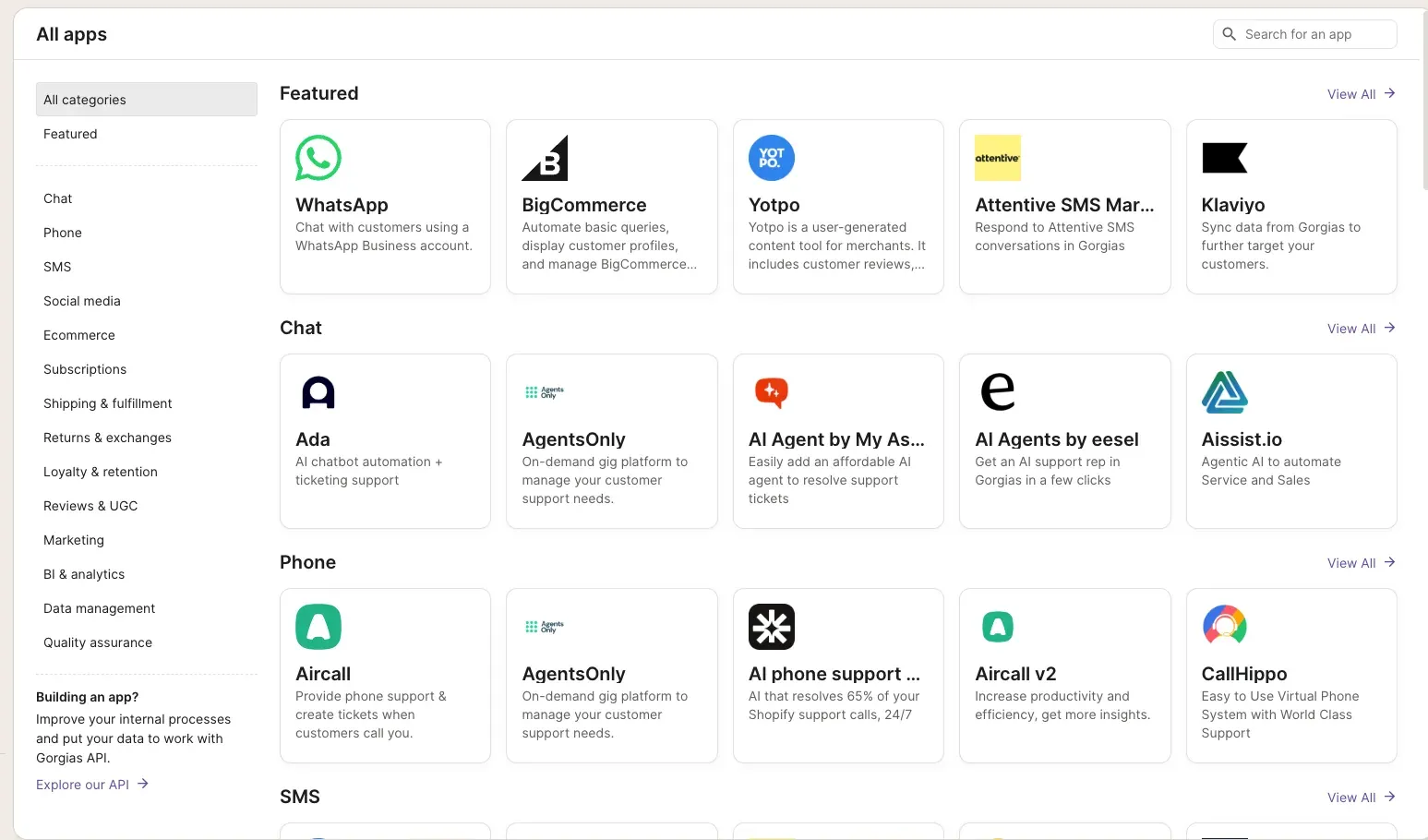
Gorgias has the larger integration ecosystem. Its official app directory says it has 100+ apps. Commslayer’s helpdesk integrations remain focused on Shopify support. Both products support API-driven extension and custom AI actions. Commslayer’s first-party MCP has been fully live since January 20, 2026 with read and write tools, while Gorgias describes its later MCP as open beta with some writes still gated.
Which has the larger integration ecosystem?
Gorgias supports more published apps and more commerce platforms at the Helpdesk layer. That is a concrete reason to choose it when a required warehouse, returns, loyalty, marketing, or commerce-platform connection already has an established Gorgias integration. Commslayer’s integration surface is narrower and concentrated on Shopify, order management, subscriptions, social support, and the apps used by its target merchants.
Which has the better API and custom-action model?
Both products support custom actions. Commslayer covers straightforward authenticated REST calls and many Shopify or subscription workflows through predefined actions. Gorgias exposes more in-product custom-action controls.
Which has the better MCP?
Commslayer says its first-party MCP for Shopify support has been fully live since January 20, 2026. The current production implementation exposes account-scoped read and write tools for conversations, help-center content, AI guidance, canned responses, automation rules, and testing, although its public help article still carries an outdated early-beta label. The launch date is documented in the January 20, 2026 announcement.
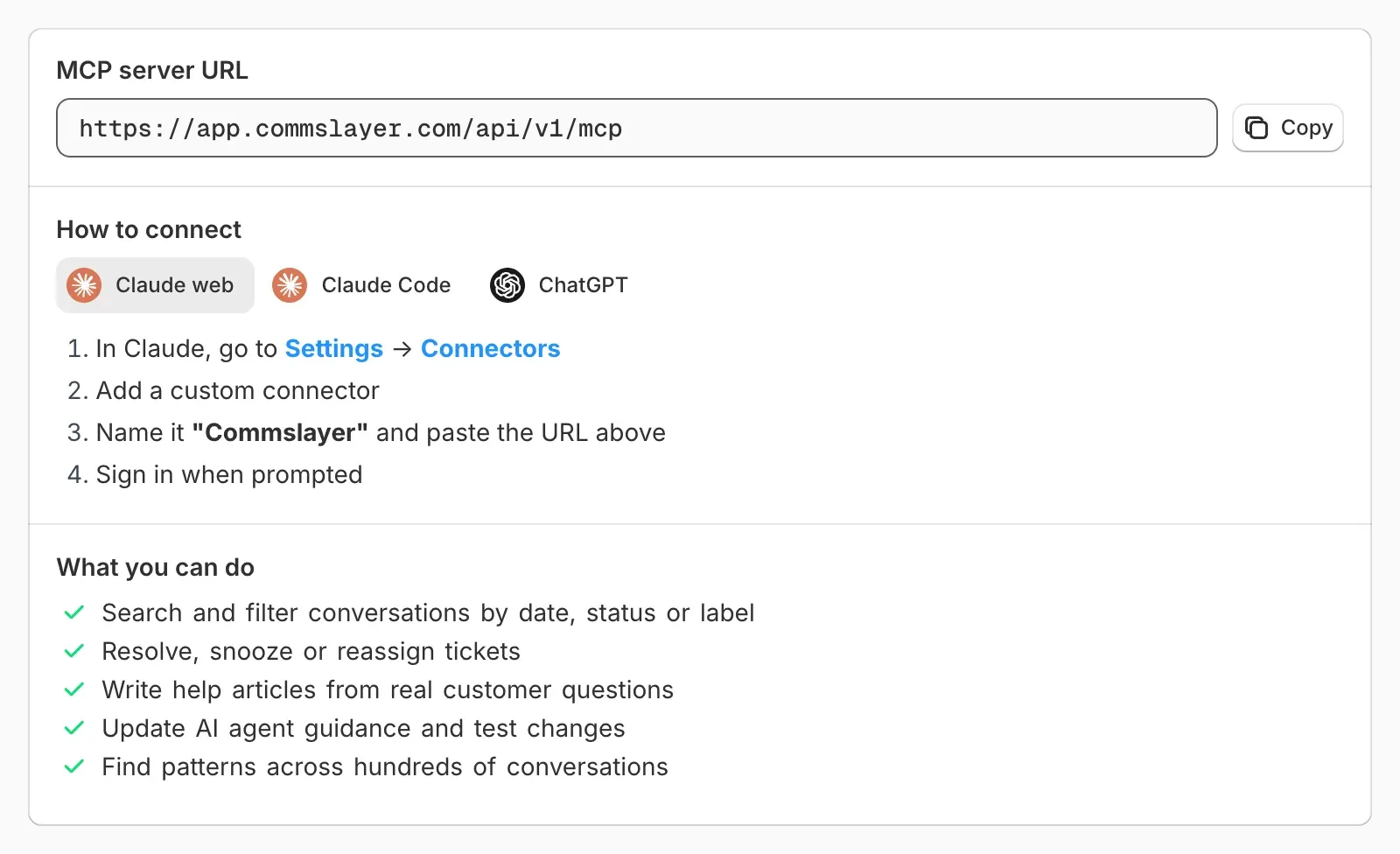
Gorgias announced its MCP in open beta. Gorgias says reads are live while some writes, including parts of Macro editing and AI Agent configuration, remain gated during the beta. Both products can therefore support useful AI-assistant workflows, but their lifecycle status is not the same.
Buyers should still compare authentication, permissions, auditability, destructive-operation controls, available tools, and the exact assistant they plan to connect.
What do Shopify merchants report?
Recent Shopify App Store reviews are more positive for Commslayer and more polarized for Gorgias, but they are directional buyer evidence rather than a controlled product test. The newest 50 reviews for each app were sampled on August 24, 2026 using the same newest-first method. Commslayer’s reviewers are mostly newer users, while Gorgias has many more multi-year reviewers, so the distributions should not be read as a retention comparison.
The listing-level snapshot on August 25, 2026 was 4.9 from 199 reviews for Commslayer and 4.3 from 627 reviews for Gorgias.
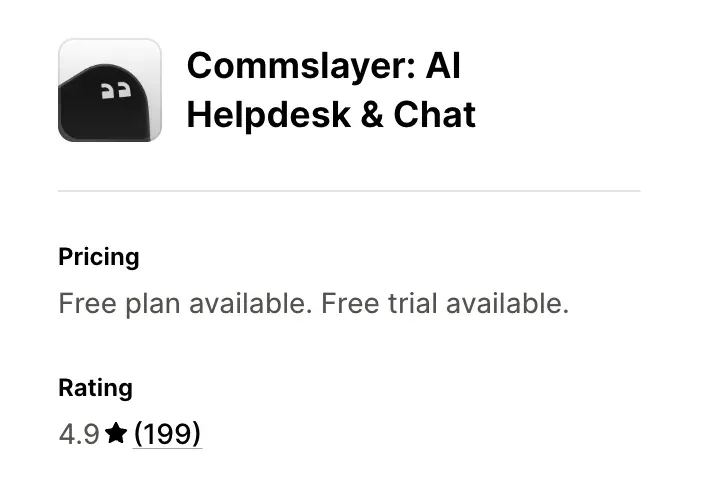
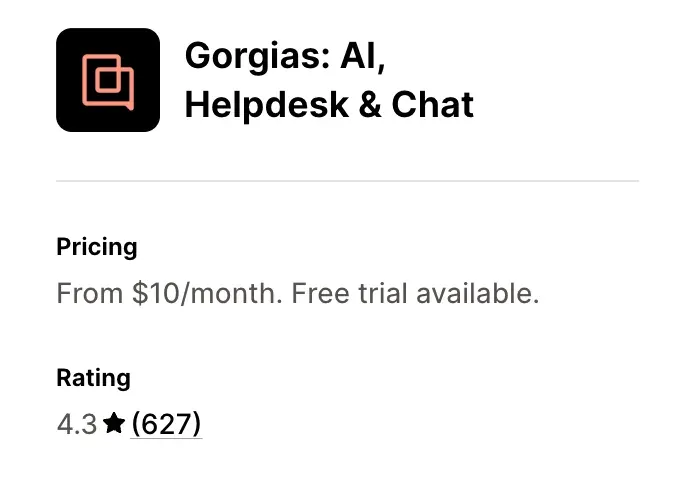
What does the newest-50 review sample show?
The Commslayer sample contained 47 five-star reviews and three reviews below five stars. The Gorgias sample contained 31 five-star reviews and 19 reviews below five stars. Reviews are self-selected experiences, and several ratings contain no written text.
| App | Review date range | 5 star | 4 star | 3 star | 2 star | 1 star | More than one year of stated tenure |
|---|---|---|---|---|---|---|---|
| Commslayer | April 23 to August 21, 2026 | 47 | 1 | 0 | 1 | 1 | 5 of 50 |
| Gorgias | April 9 to August 21, 2026 | 31 | 4 | 3 | 2 | 10 | 27 of 50 |
Commslayer’s recurring praise centered on support, onboarding, responsiveness, direct team access, price and value, AI and automation, ease of setup, and fast feature delivery. Critical or qualified feedback included one missed onboarding call, one report of inconsistent AI answers and weak documentation retrieval, a layout learning curve, and the need to train and tune AI. For examples, see Sunray Fly Fish on fit, price, and direct support; Meatformore.nl on natural answers and training work; and The Mushroom Barn on inconsistent AI retrieval.
Gorgias’s positive reviewers often praised named account support, AI Agent and Shopping Assistant, channel consolidation, reporting, customization, Shopify integration, macros, and operational familiarity. Its critical reviews more often raised support or onboarding delays, bugs or missing features, synchronization problems, price or AI overages, and contract flexibility. The four-star reviews added important nuance: knowledge setup and monitoring still take work, occasional hallucinations occur, and human oversight remains important. Examples include Ancestral Supplements on customization, metrics, and account support; Free Fly Apparel on positive AI onboarding plus ongoing monitoring; and GPerformance on the removed human live-cart view and AI-price concerns.
The Gorgias sample contains a larger group of long-tenured reviewers. That is consistent with an older product and installation cohort, but it does not establish that those merchants are enterprise customers or that one app retains customers better.
What do approved Commslayer customers say?
Approved customer posts are useful public proof, but they are not part of the newest-50 review sample. Phil Kyprianou is a Commslayer customer. In a March 2026 public post, he described Commslayer as a lower-cost Gorgias replacement and said his team uses Claude to manage agents and populate the knowledge base. That is Phil’s reported experience, not an independent normalized cost calculation.
Phil also announced his move from Gorgias to Commslayer in July 2025 after ten years with Gorgias. The two posts come from one customer and should not be counted as separate votes.
Bill D’Alessandro’s September 2023 post belongs in a different category. It records dated industry criticism of Gorgias’s 2023 pricing change, not a current App Store review or a current pricing source. Current buying decisions should use the first-party pricing calculation in this article.
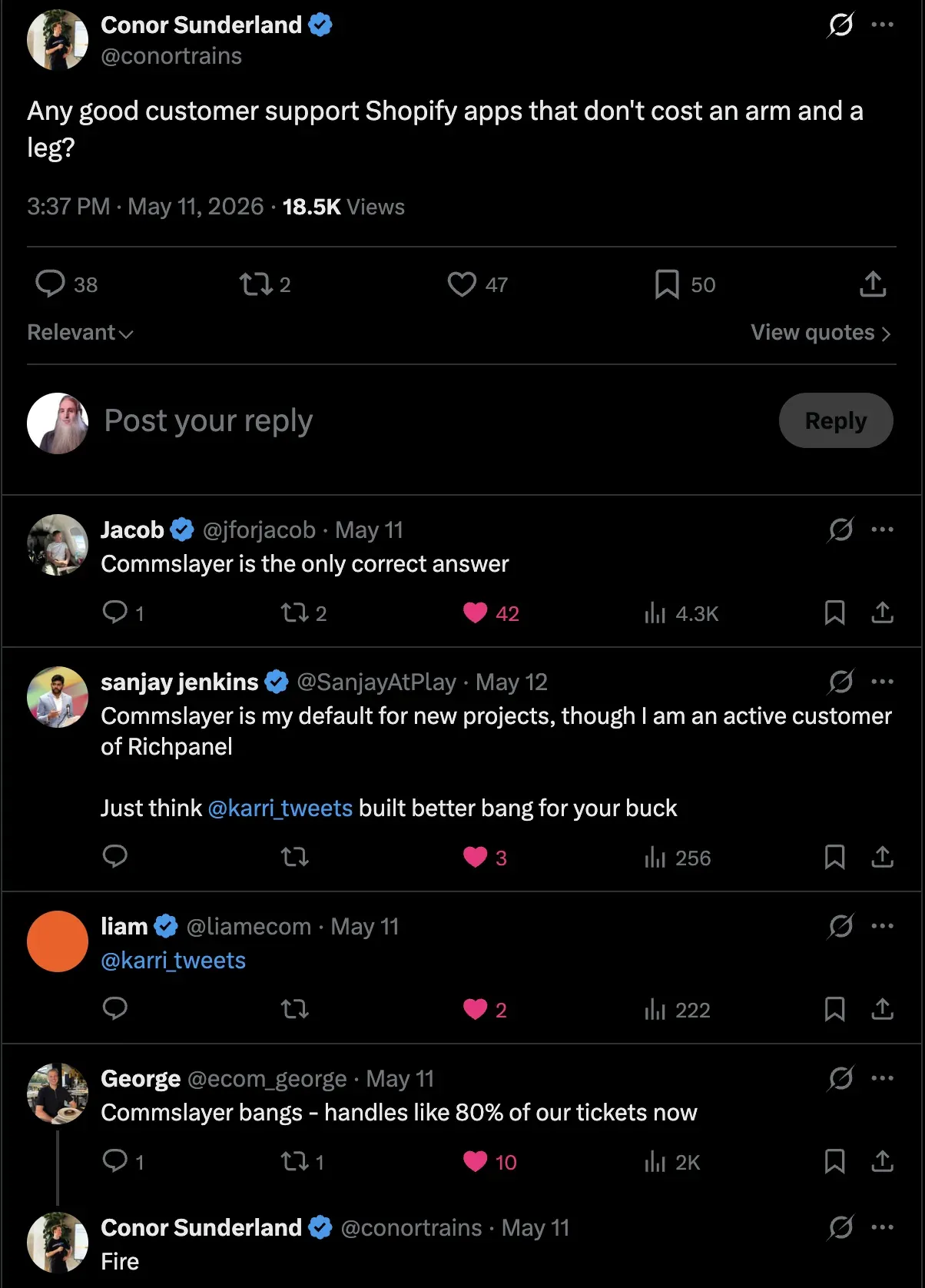
On May 11, 2026, Conor Sunderland asked on X for “good customer support Shopify apps that don’t cost an arm and a leg,” and multiple public accounts recommended Commslayer without prompting: “Commslayer is the only correct answer” and “Commslayer bangs - handles like 80% of our tickets now”. These are unprompted public recommendations in reply to a cost question, but they are directional signals only: the repliers are self-selected public accounts and were not verified as Commslayer customers.
How did the two companies get here?
Commslayer was started by the two founders behind Lifetimely, a popular customer analytics app for Shopify used by thousands of merchants before it was acquired by Amp in 2022. Its cofounders now build Commslayer from Finland and Boston, with the Boston-based cofounder serving as CTO. The company says it is bootstrapped and profitable, with more than 3,000 Shopify brands using the platform.
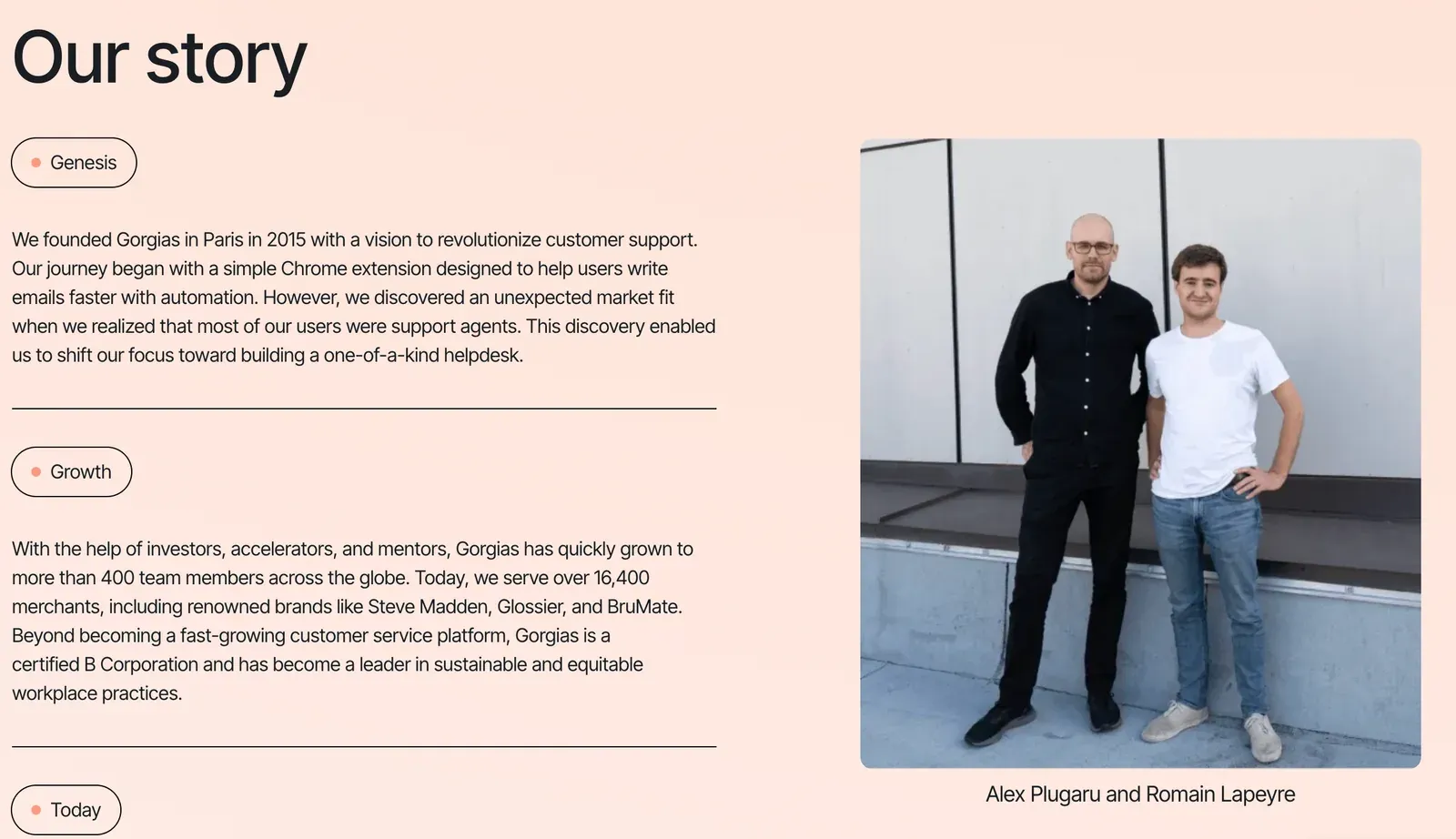
Gorgias says it began in Paris in 2015 as a Chrome extension for writing email faster, then shifted toward customer support after discovering that many users were support agents. Its About page currently reports more than 400 employees, 16,400 merchants, and $100 million in total funding. Cofounder Romain Lapeyre remains CEO. Cofounder and former CTO Alex Plugaru wrote in May 2026 that he had stepped down as CTO to start Elench, and described the departure positively.
The funding difference shows up in go-to-market scale. At a SaaStr panel, Gorgias’s senior director of growth operations described the company’s fully automated outbound engine: about one million emails sent in the prior quarter across a total addressable market of a couple hundred thousand companies, triggered by signals such as CX job postings and newly installed apps. In a separate SaaStr talk, Gorgias CEO Romain Lapeyre said “about 20% of our revenue” comes from self-serve product leads the sales team does not engage with, and 80% from inbound leads it does. Commslayer runs no automated outbound program and is bought self-serve.
Can Commslayer replace Gorgias without disrupting support?
Yes, Commslayer can replace Gorgias for a Shopify-first team when the migration is staged, each live channel has one primary receiver, and Gorgias-specific rules and integrations are rebuilt before cancellation. The main documented cutover risks are overlapping channel ownership, unimported automations, and incomplete validation.
What is imported from Gorgias?
Commslayer’s Gorgias importer covers ticket history, contacts, tags, agents, and response templates. Historical conversations land in a read-only import inbox so agents can reference the prior customer record while new work happens in Commslayer.
The broader migration checklist says a typical import takes one hour to one day depending on the dataset. Treat that as a planning range, not a guaranteed service level.
What must be rebuilt or verified?
Rules and automations do not import automatically. Claude, and other assistants that support MCP writes, can use Commslayer MCP’s first-party tools to create or update automation rules, AI guidance, canned responses, and help-center content after a human reviews the proposed changes. Teams should also inventory and validate views, integrations, response variables, phone routing, social ownership, permissions, reporting, and every high-risk order or subscription action.
MCP can reduce the manual setup, but it does not remove validation. Record the current Gorgias trigger, condition, output, owner, and test case for every workflow before recreating it. Then test the Commslayer version with synthetic or low-risk customers and orders.
Can both systems run during migration?
Yes, Commslayer and Gorgias can run simultaneously during setup, import, and validation, but only one system should be the primary receiver for each live channel. Duplicate email forwarding, webhook ownership, or social connections can create double replies and conflicting automation.
Keep Gorgias receiving production traffic while Commslayer is configured. Validate imported history and run test conversations in Commslayer without turning on overlapping channel ownership. During cutover, switch each channel deliberately and monitor both inboxes for duplicates, misses, and delayed events.
What happens during final cutover?
A safe cutover uses this sequence:
- Inventory channels, rules, views, macros, integrations, phone numbers, help-center URLs, AI guidance, and enabled actions in Gorgias.
- Connect Shopify and run the initial import into Commslayer.
- Rebuild rules, integrations, response templates, help-center content, and action guardrails.
- Validate email, chat, social, phone, translation, and high-risk actions using controlled records.
- Choose a low-volume window and make Commslayer the primary receiver for each channel.
- Run the documented final Gorgias re-import so remaining conversations are captured.
- Keep Gorgias access while completing required exports and checking the final re-import, routing, permissions, reports, and action outcomes. Cancel only after reconciliation passes.
This sequence keeps history and export access available through the final routing checks and reconciliation, while reducing the chance that both systems reply to the same shopper.
Before you sign: what to test
One set of matched tests in both configured accounts answers more than any feature table. Use the same knowledge, customers, channels, policies, and action guardrails in both, and score answer quality, handover recovery, action success, administrator work, and the actual units each vendor bills. Before committing, run:
- Restricted-topic handover test: send the same restricted topic and high-risk action into both systems with matched customer and order context. Record whether AI hands over, whether the action runs, what the audit trail shows, and how an administrator can recover from a failed action.
- Channel matrix test: send the same email, chat, DM, and public comment into both accounts. Record who can see it, whether AI can reply, whether AI can act, and what unit is billed. For social, also check comment ingestion, hiding, replies, ad comments, mentions, DM handoff, and Meta reply windows.
- Help-center render test: check both implementations for a 200 response, article text in the initial HTML, indexability, canonical URL, sitemap inclusion, internal links, one useful H1, title and meta description, structured data, duplicate-content behavior, and crawl depth.
- Phone proof of concept: test queues, missed calls, transfers, recording consent, callbacks, business hours, number porting, and reporting against the support team’s actual workflow.
- Financial-action edge cases: test unfulfilled, partially fulfilled, discounted, subscription, gift-card, multi-currency, and partially refunded orders before any autonomous financial action.
- Integration three-way check: for each required app, confirm whether it appears in the human sidebar, whether AI can read it, and whether AI can write to it safely.
Which should you choose?
Choose based on the requirements the team can name and test. Commslayer has the modeled cost and predefined-action advantage for Shopify-only teams. Gorgias may justify its higher modeled cost when a required integration, non-Shopify platform, enterprise control, reporting workflow, phone setup, or custom automation is decisive.
Choose Commslayer if…
Commslayer fits if most of these statements are true:
- Shopify is the only commerce platform the helpdesk needs to support.
- Lower total cost and a month-to-month commitment matter, with one plan containing conversation and AI-message allowances rather than a separate AI tier.
- Many teammates need access.
- AI should execute several predefined Shopify order actions.
- Human agents should get an automatic AI draft on every incoming conversation, with no extra step to generate it.
- Standalone guarded refunds are part of the support policy.
- Subscription work spans Recharge, Loop, Skio, Appstle, Stay AI, or Kaching.
- Human replies should translate automatically in both directions.
- Public Facebook and Instagram comment moderation is a major requirement.
- Customer-facing checkout thank-you-page order editing should replace a separate order-editing app.
- Help-center pages should live on the Shopify store domain inside the store theme.
- Direct founder access, a self-serve start, and a fully live read/write MCP are valuable.
See current Commslayer pricing, start free on Shopify, or plan a Gorgias migration.
Commslayer has real limits. It is Shopify-only, its current public materials document fewer enterprise administration controls, and its integration catalogue is smaller than Gorgias’s. Buyers should verify required identity, audit, permission, security-review, account-management, call-routing, and reporting workflows directly.
Choose Gorgias if…
Gorgias fits if one or more of these statements is decisive:
- The same Helpdesk must support Shopify and other commerce platforms.
- A required integration already has a proven Gorgias implementation.
- Enterprise procurement needs specific identity, audit, security, legal, or account-management controls; confirm plan eligibility for each one.
- The CX team relies on established Gorgias reporting, roles, views, macros, rules, and workforce workflows.
- Custom automation needs a visual multi-step builder with conditions and logs.
- Shopping Assistant and current-session cart context are central to pre-purchase support.
- The team prefers Gorgias’s documented phone queue, IVR, transfer, and callback features with ticket-based Voice billing.
- The team is comfortable budgeting and tracking two separate usage meters, Helpdesk tickets and AI interactions, across more parts of the product.
Before signing either contract, run the checklist above on the same 30 conversations in both systems: ten WISMO questions, ten order or subscription changes, and ten unusual escalations.
Methodology and last verified
This comparison was researched from current public pricing and first-party help documentation, current Commslayer production code and customer-visible settings, non-destructive checks in an active Gorgias account, and a same-date newest-50 Shopify App Store review sample for each product. Capability evidence was classified as native, supplied by a connected integration, not verified as native but potentially buildable as a custom HTTP action, not verified, or no native standalone equivalent found. An absent action in an account without the relevant integration was not treated as proof of absence.
Pricing was normalized to four monthly support volumes with 60% AI handling, 40% human handling, two Commslayer AI Agent messages per AI-handled conversation, and no separately modeled action execution. Commslayer’s AI drafts use a separate allowance and were not added to the model. Commslayer plans were selected against the required billable-conversation and AI Agent message allowances, with every replied conversation counted as billable whether a human or the AI replied, matching Commslayer’s production billing code. Gorgias Helpdesk and AI Agent were modeled separately under the current billing documentation. Quote-only tiers were not extrapolated.
Reviews were collected from the official Shopify App Store listings, sorted newest first with no rating filter, using the first 50 visible reviews for each product on August 24, 2026. Review themes overlap and reviews are self-selected experiences, not feature verification.
Dated public social posts are cited as directional evidence where linked and are not included in the Shopify App Store review counts.
Product capabilities, prices, review counts, and beta labels change. The article was last verified on August 27, 2026.
Footnotes
-
Prices were checked on August 24, 2026 against Commslayer pricing, Gorgias pricing, Gorgias’s current billing rules, and an active Gorgias account. They exclude tax, add-ons, implementation services, and third-party apps. Gorgias annual-effective pricing is the monthly equivalent of a prepaid annual plan; on the current cards the annual discount is about 14%, for example Pro at $471/mo instead of $550 and Advanced at $1,227/mo instead of $1,430. Actual cost will vary with handovers and the number of AI replies. ↩


 Commslayer